Formation: Hippopotamus Attack
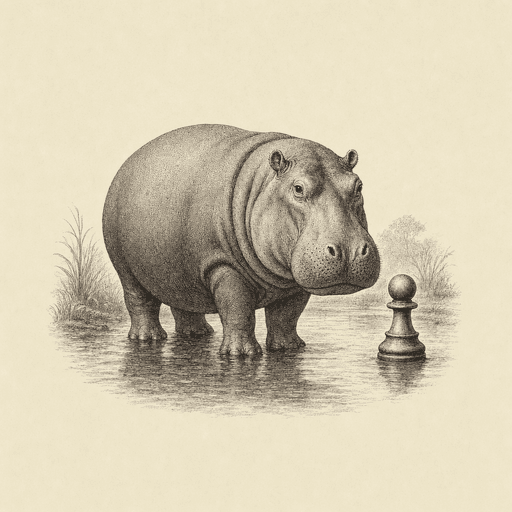
White plays seven pawn moves in a row, one square each. A wall rises along the third rank while Black simply develops pieces.
This is a formation with a name but no theory behind it. White nudges every pawn from the a-file to the g-file exactly one square forward while Black takes the center, develops both knights and a bishop, and castles. The Hippopotamus family claims this setup as one of its own. It sits low in the water, refuses contact, and dares the opponent to come in. The classic Hippo at least develops pieces inside its shell. This version takes the idea to its logical extreme. The shell is the entire opening.
The steelman first: no White pawn stands past the third rank, so there are no targets. Any break Black makes gets met with a capture toward the center. Nothing hangs, the structure stays compact, and White plans to develop behind the wall with Bg2 and knights to e2 and d2 before choosing one well-timed strike at Black's big center. The counterargument reads from the board itself: Black owns the middle, leads enormously in development, and has castled while White's pieces sit in their wrappers.
The fight that follows breaks into clear shapes. Black either pushes ...e4 to gain space and force the coiled position to declare itself, or keeps the tension. Calm improvements like ...Re8 and ...Be6 follow until every Black piece outranks its opposite number. White's hope is that the closed character of the game blunts all of this. At club level, the numbers say that hope amounts mostly to mud.
Finish the shell, then finally join the game. Bg2 is the one genuinely good piece this setup produces. The knights come to e2 and d2 where everything stays defended, and the king tucks in behind the wall. From there White waits. The entire strategy is to present no targets, let Black commit the big center, and then pick one break: c4 against d5 or f4 against e5, chosen at the moment of maximum structural damage.
You have already won the opening, so the plan is not to spoil it. Either gain more space with ...e4 (the most direct test of the wall) or build quietly. Moves like ...Re8 and ...Be6 bring pieces to their best squares. Open the position only when everything is ready. The one losing idea is impatience. Hurling pawns at the wall closes the game and gives the hippo exactly the swamp it wants.
The full formation is genuinely rare at club level (1600-2000 on Lichess). Just 502 games in our database reach it. It also underdelivers: from the position one move earlier, White completes the wall with 7. g3 in 87.5% of games and scores only 40% doing it. Black's most popular reply is the space-grabbing 7...e4 (27.9%). Black scores 65% with this move. The quieter 7...Be6 (17.3%) scores 58% for Black, and 7...Re8 (19.7%) scores 54%. The wall is easier to admire than to defend.
- Family
- Formation
- Category
- Flank
- First move
- Other
- ECO
- A00
- Line
- 1. a3 e5 2. b3 d5 3. c3 Nf6 4. d3 Nc6 5. e3 Bd6 6. f3 O-O 7. g3