Where your pieces actually go
We replayed 29,032 games half-move by half-move and wrote down every square every piece stood on. Your knights live on two squares, and your queen's bishop barely gets out of bed.
Ask a club player where their pieces spend the game and you get a description of intentions. Bishops cutting across the board. Knights landing on strong squares. A rook arriving on the open file at the right moment. The board keeps a different record, and it is not flattering.
So we read it. 29,032 rated rapid and blitz games belonging to 542 players, replayed one half-move at a time, with a note of the square every piece was standing on at every moment it was still on the board. No more than 60 games from any one player. Every player's numbers averaged inside that player before anything was averaged across players, so nobody's habits can drown out everybody else's.
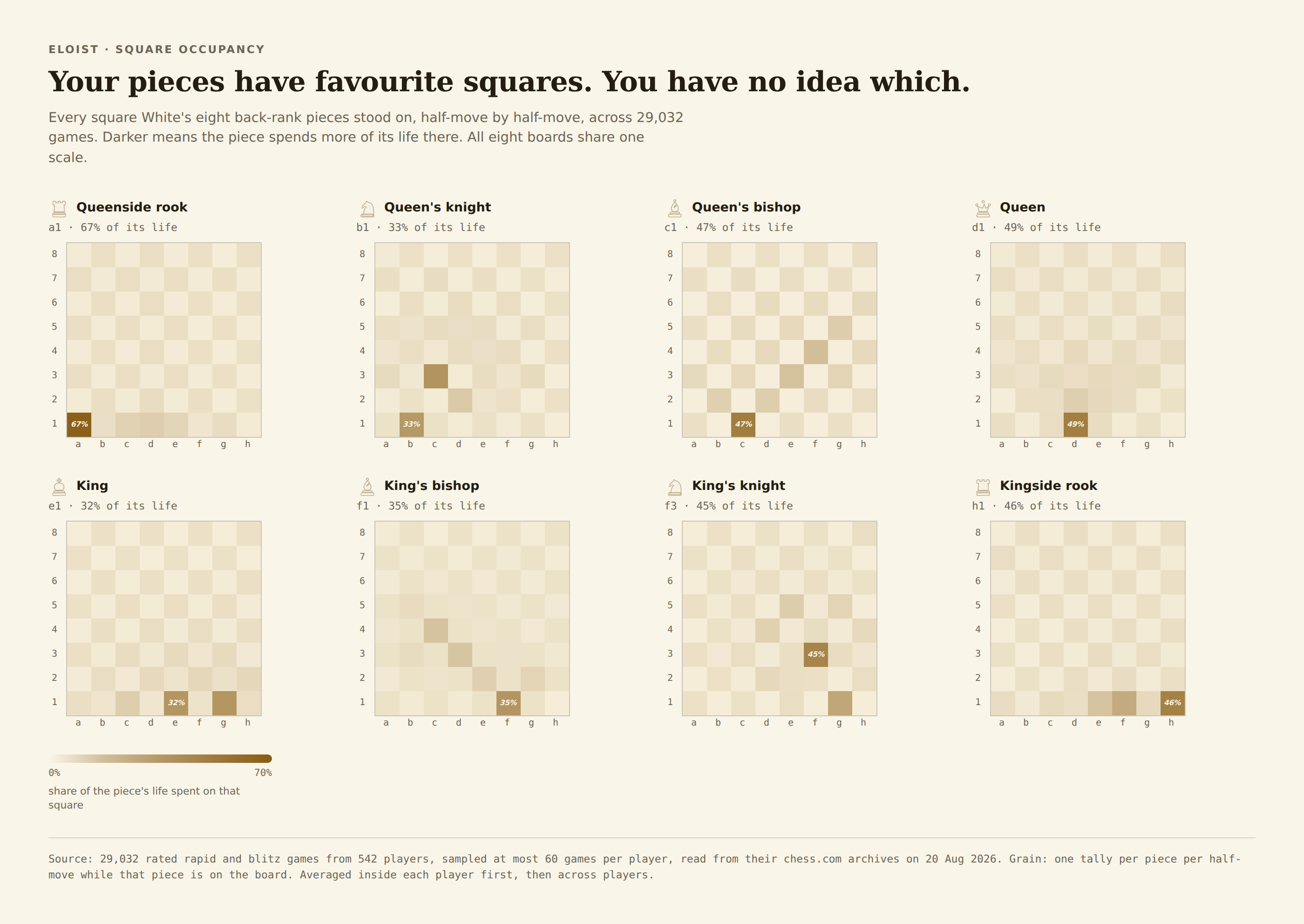
The picture above is the whole of White's back rank, one board per piece, all eight on the same scale. Square by square there is nothing in it you could not have guessed. What surprises people is how dark the home squares are.
The bishop that never gets up
White's queen's bishop spends 47.4% of its life on c1. Black's spends 51.3% of its life on c8. Not the first few moves and not the opening: half of every half-move it is on the board, measured over 14,553 games as White and 14,470 as Black.
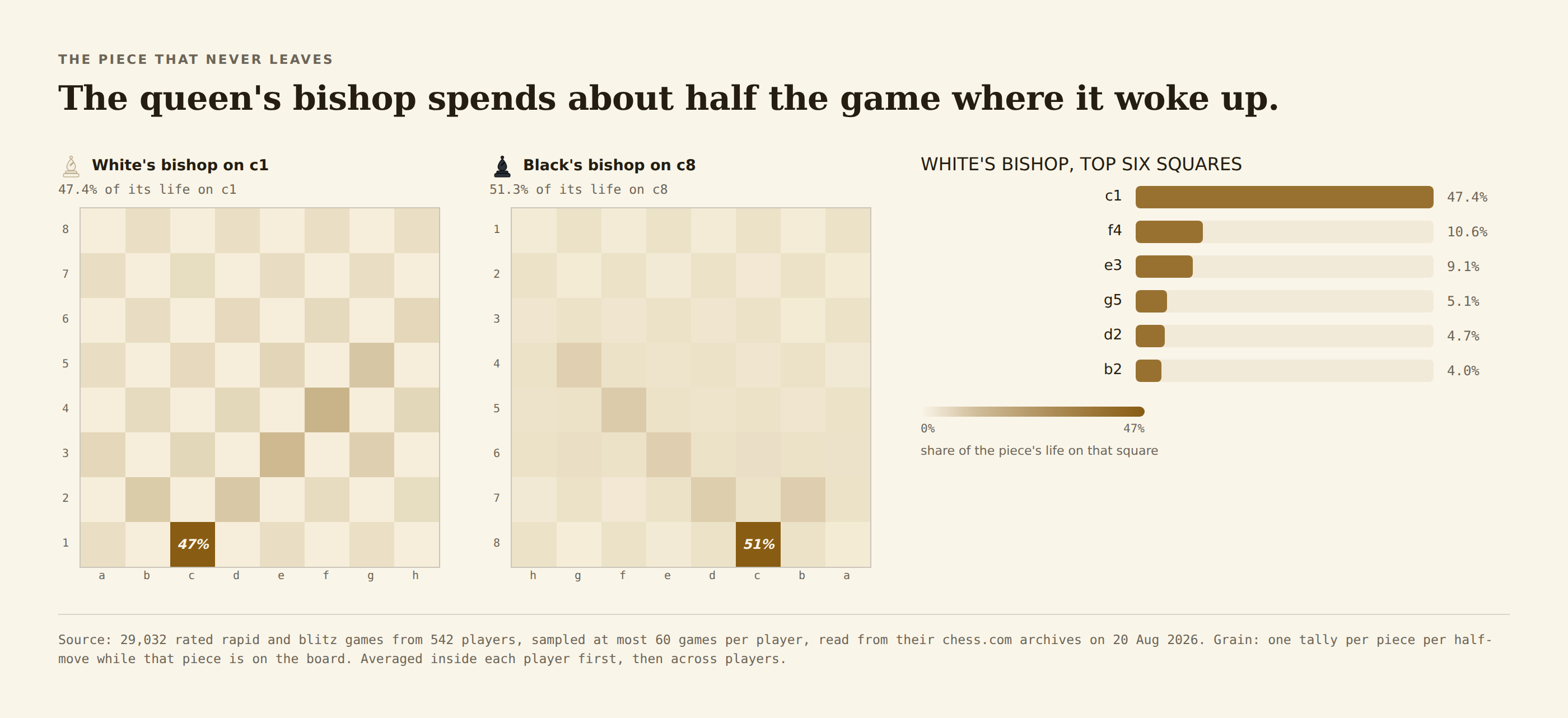
The king's bishop does better, at 35.0% on f1 and 40.6% on f8, over the same games from 541 distinct players as White and 542 as Black. That gap has nothing to do with light squares against dark ones. White's stay-at-home bishop starts on a dark square and Black's starts on a light one. What the two have in common is the queenside. A king's bishop has to move before you can castle, so it moves. The other one waits for a reason, and the reason often never arrives.
Knights on two squares
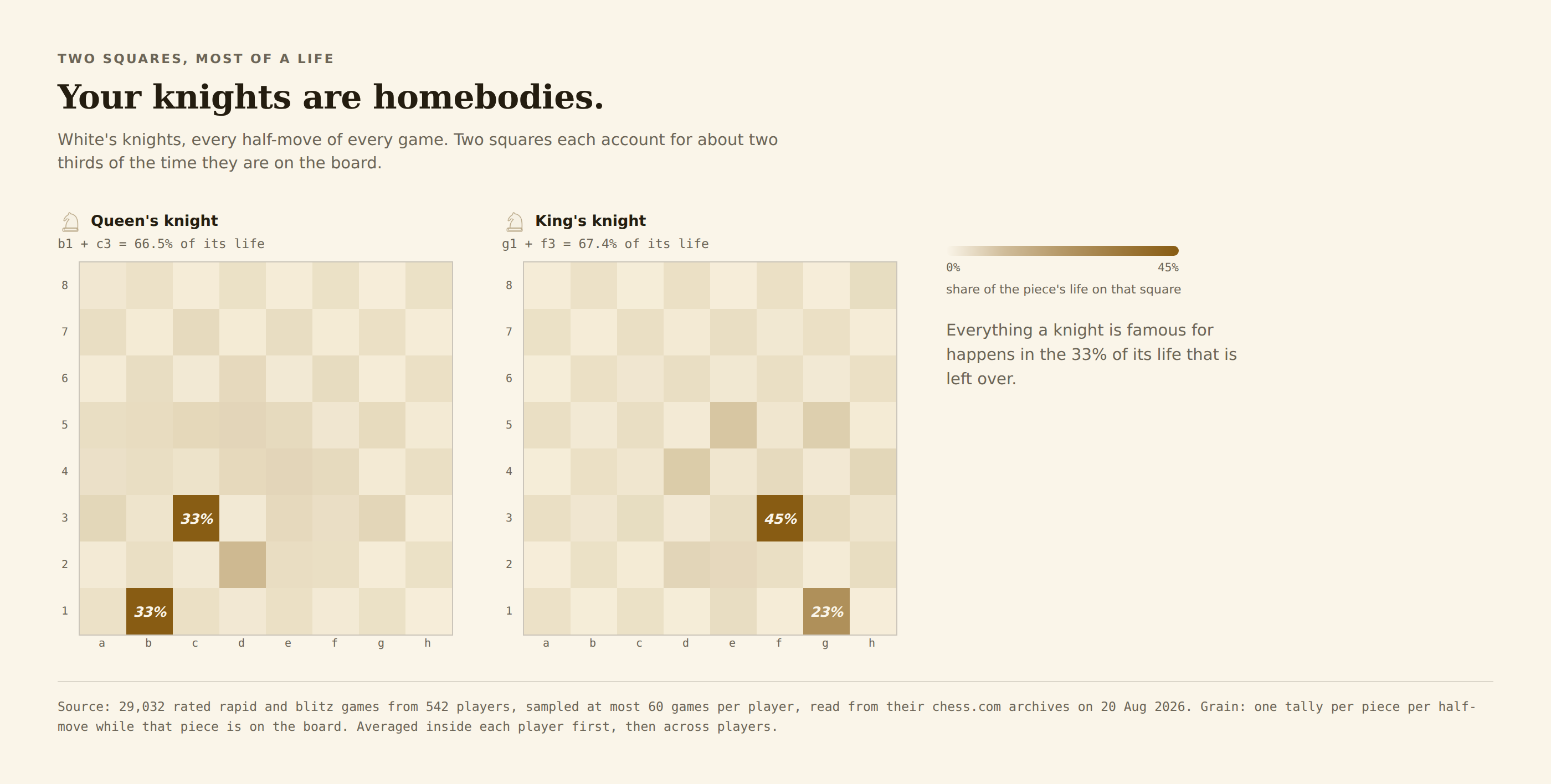
Your queen's knight spends 66.5% of its life on b1 and c3. Your king's knight spends 67.4% of its on g1 and f3. Everything a knight is famous for, the forks and the outposts and the jumps nobody sees coming, happens in the third of its life that is left over.
How much board a piece really uses
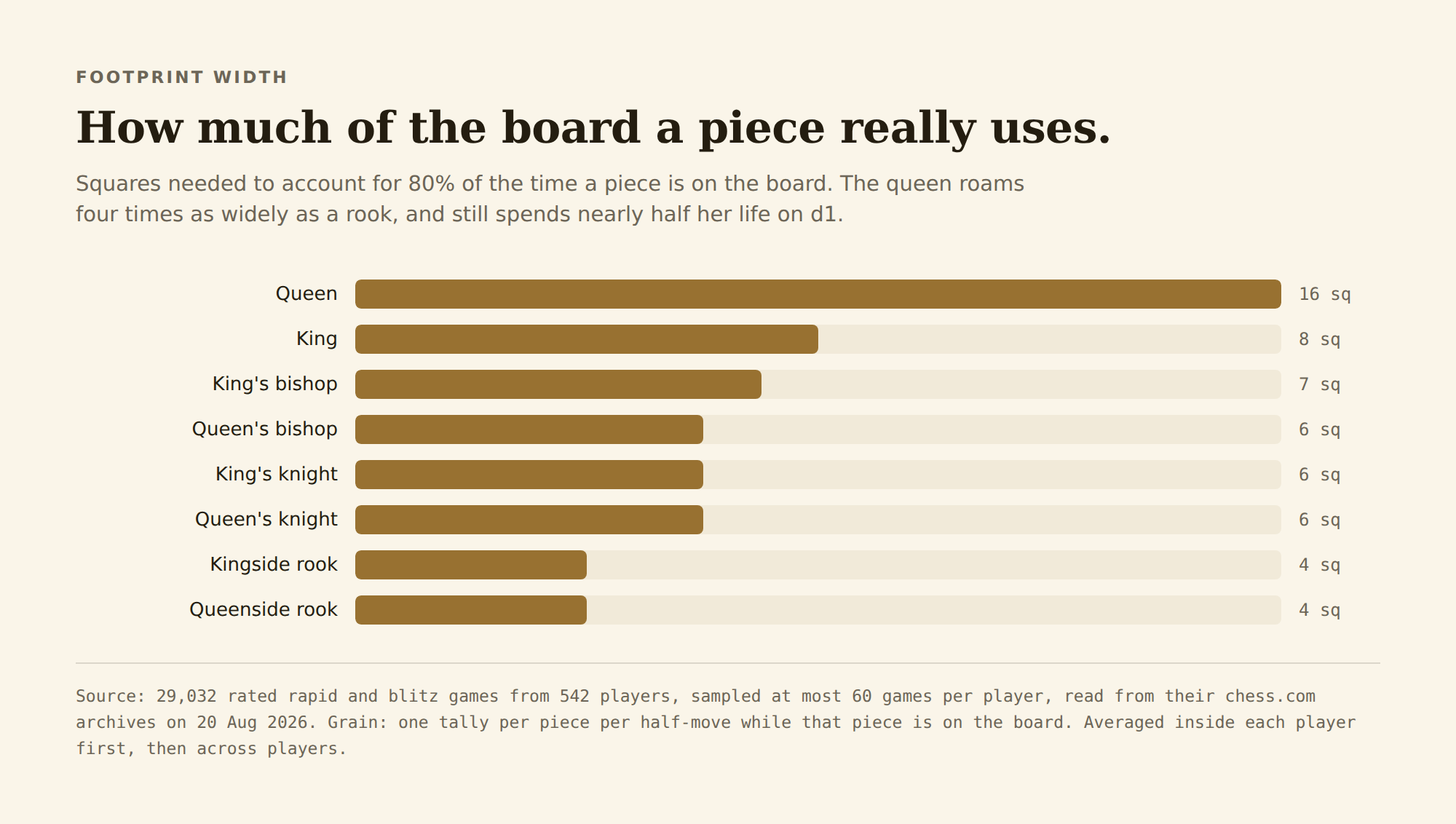
Count how many squares you need before you have covered 80% of a piece's life and you get a ranking that has little to do with how far a piece can move. Four squares cover a rook. Six cover a knight. It takes sixteen for the queen, the only piece in the set that genuinely wanders, and she still spends 48.6% of her life on d1.
An opening is a set of instructions for one bishop
Openings have reputations, and this is one you can check. Here is Black's queen's bishop in three different defences, from the same corpus of ordinary rated games.
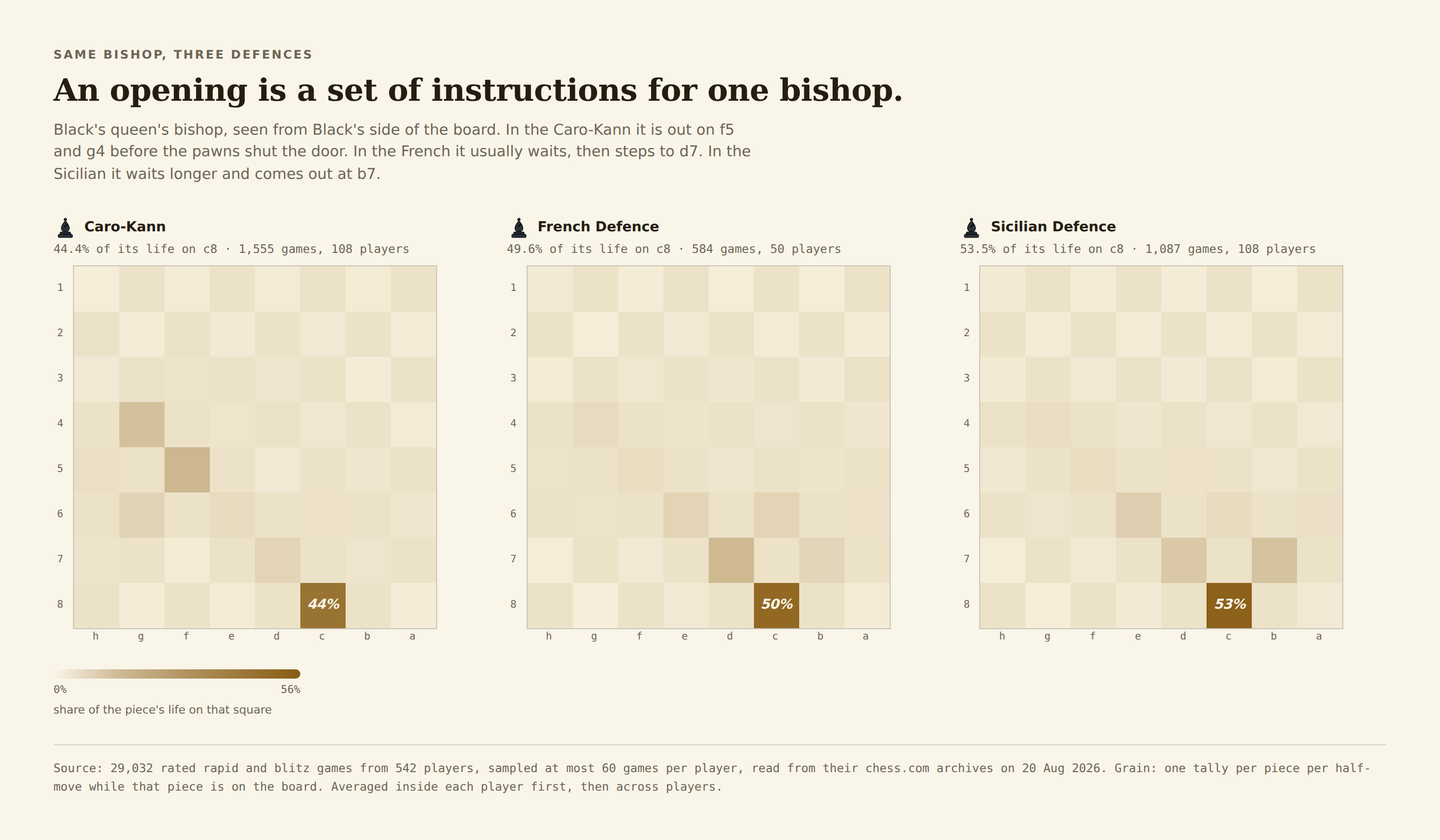
In the Caro-Kann that bishop is out early: 44.4% at home, 14.4% on f5, 10.9% on g4, across 1,555 games from 108 players. In the French it stays in at 49.6%, and when it does move it goes to d7, across 584 games from 50 players. In the Sicilian it stays in longest of all at 53.5%, and its one real excursion is b7, across 1,087 games from 108 players.
That is the Caro-Kann's entire sales pitch in a picture. Get the bishop out before the pawn on e6 shuts the door. Of everything we measured, it is the claim the board backs with the least argument.
What actually changes as you get stronger
Compare rating bands over whole games and every piece looks busier at the top. Most of that is time, not skill. Games in the 1800-and-up band run 76.2 half-moves on average against 57.9 in the under-1000 band, and a longer game gives every piece more chances to be somewhere else. So for this section we counted only the first 20 moves, and only games that lasted 20 moves, which puts every band on the same clock.
Under that rule most of the differences go away, except the king's. Across White's games from 255 distinct players in the bottom band and 91 in the top, time on e1 falls from 53.9% under 1000 to 48.8% at 1800 and up, and time on g1 climbs from 32.1% to 40.9%. The kingside rook follows the king out, from 62.9% on h1 to 54.3%.
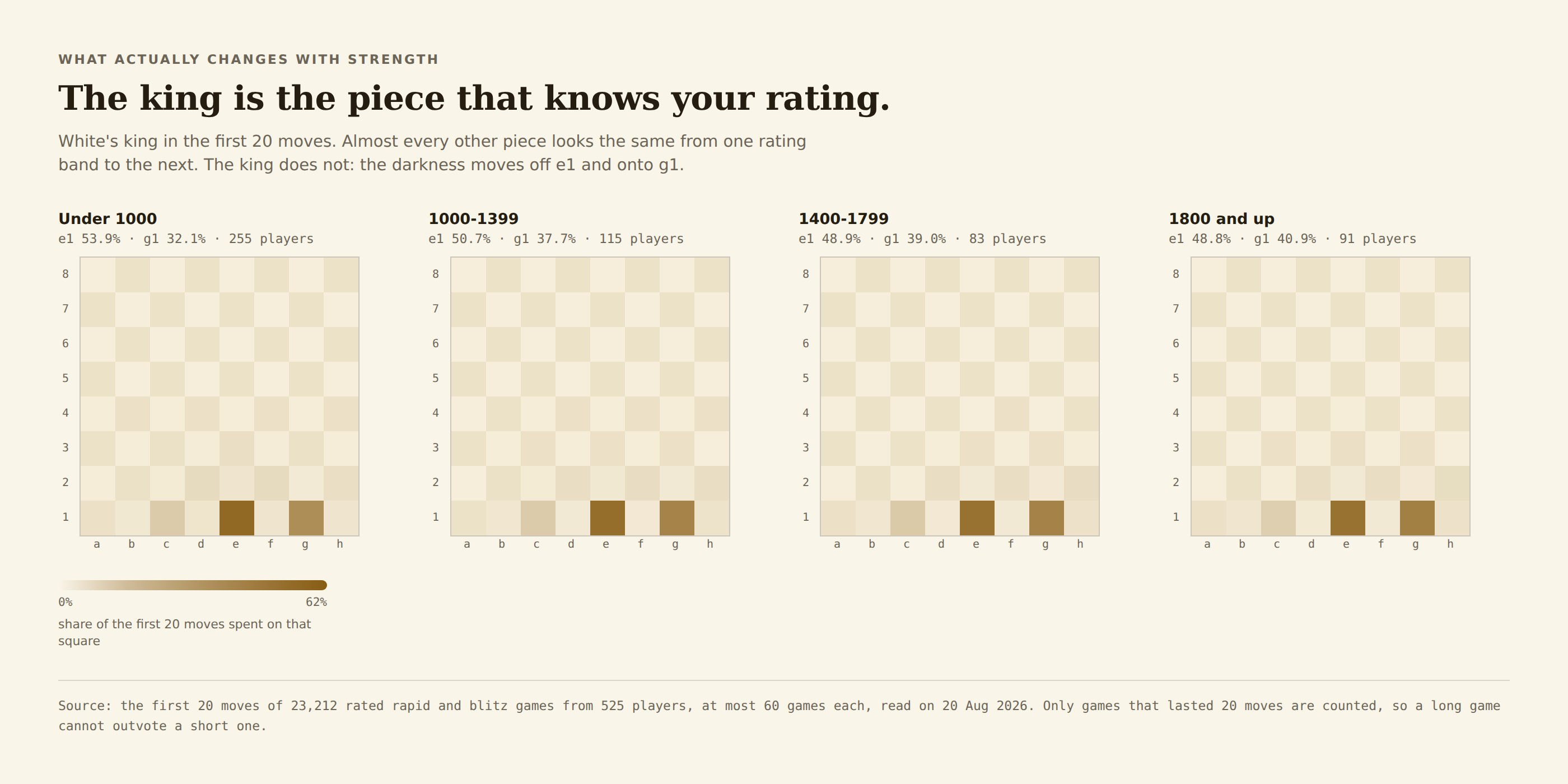
It is a small number carrying a large idea. Getting stronger, in this data, looks less like finding new squares for your pieces and more like getting your king off the middle of the board sooner.
Your good games look like your bad ones
Which leaves the question everybody actually wants answered. Is there something visible about the games you win? We took the same players and split their games in two, wins on one side and losses on the other, first 20 moves only. 439 players had at least six of each, 4,945 wins against 4,689 losses.
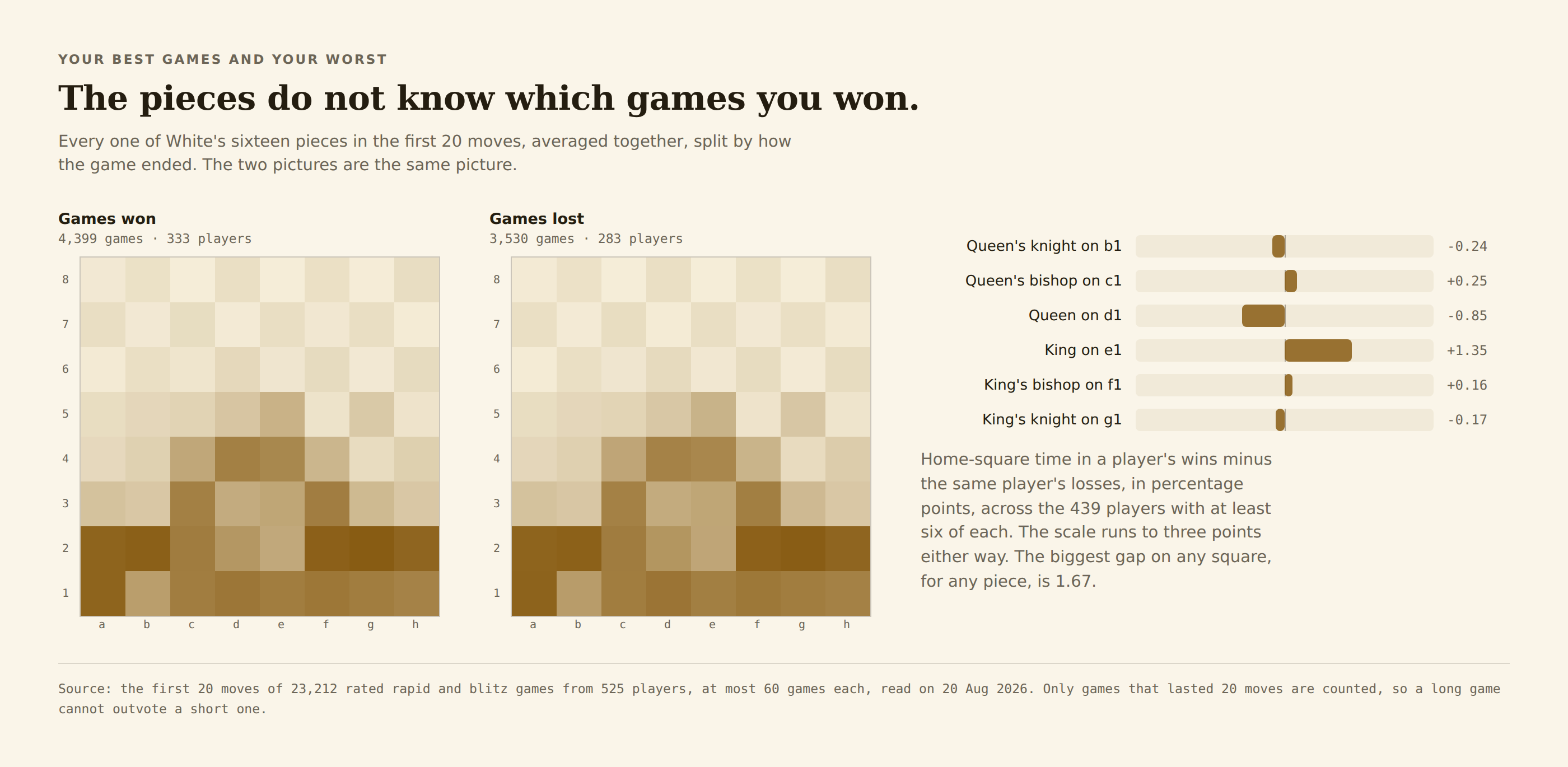
The two boards are the same board. Across all sixteen pieces and all sixty-four squares, the largest single difference is the h-pawn, which spends 1.67 percentage points more of the first 20 moves on h2 in games that were won, give or take 0.54. The king is next at 1.35 points more time on e1 in wins. Nothing else clears a point and a half.
So whatever separates your best games from your worst, it is not where your pieces went in the first 20 moves. It is what they did once they got there. Which is a relief, in a way. There is no secret arrangement you are failing to find.
What to do with this
Two things are worth keeping. Your pieces are much less mobile than your memory of them, and the opening you choose is the strongest thing you can change about where they will sit. If you want a different board, the cheapest place to change it is move three.