We were wrong about annual
For six days our pricing page asked you for a year up front. Here is what that cost, what we still cannot prove, and the worse mistake we made fixing it.
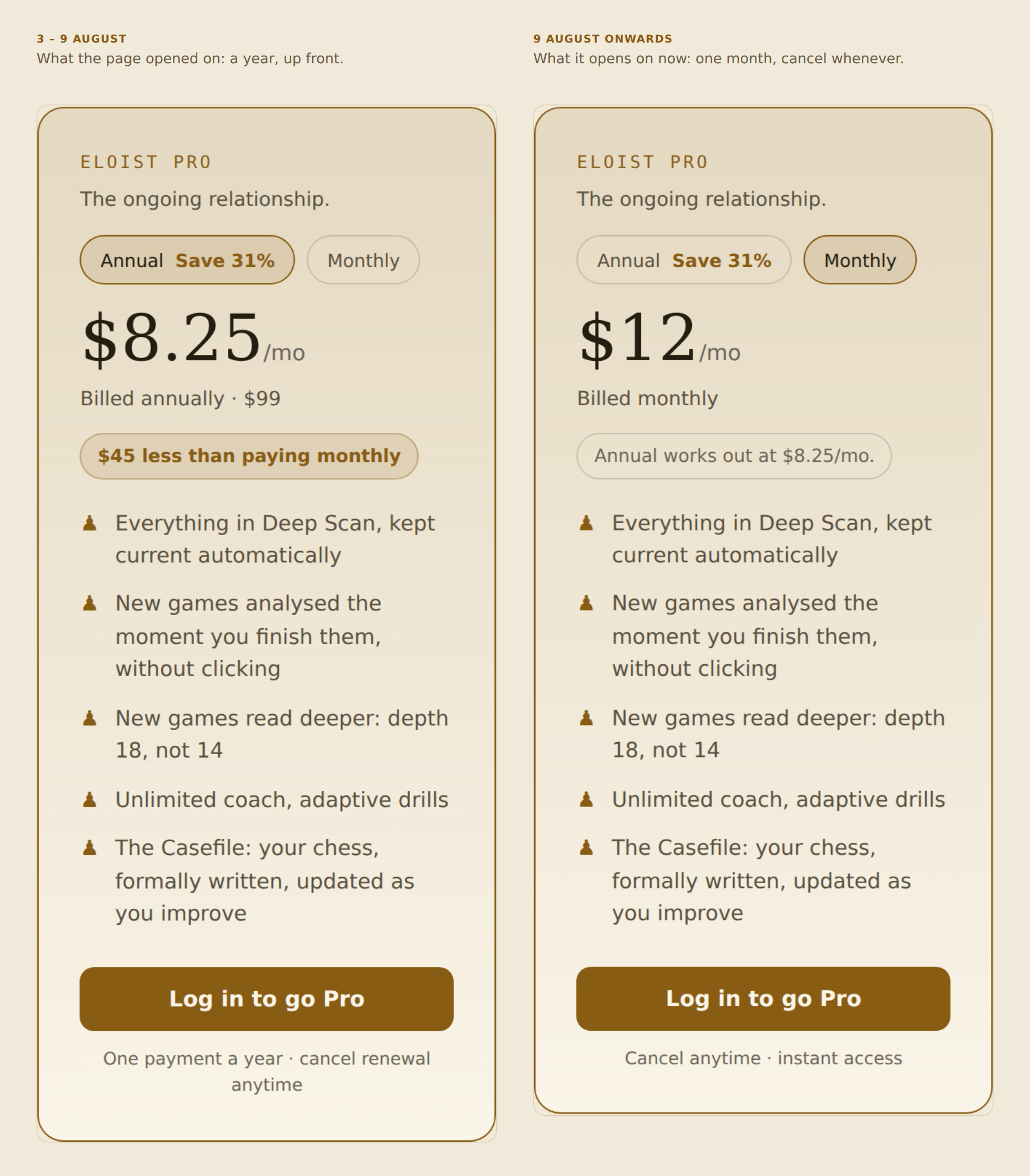
On 3 August the pricing page stopped opening on the monthly plan and started opening on the annual one. Six days later, on 9 August, we put it back. This is the story of those six days, written from our payment records and our click log with internal accounts excluded, rather than from memory, and it does not end with us being clever.
Nothing about the offer changed in that week. Same features, same two prices, same switch on the same card. The only thing that moved was which side of the switch was already pressed when you arrived.
What the page looked like
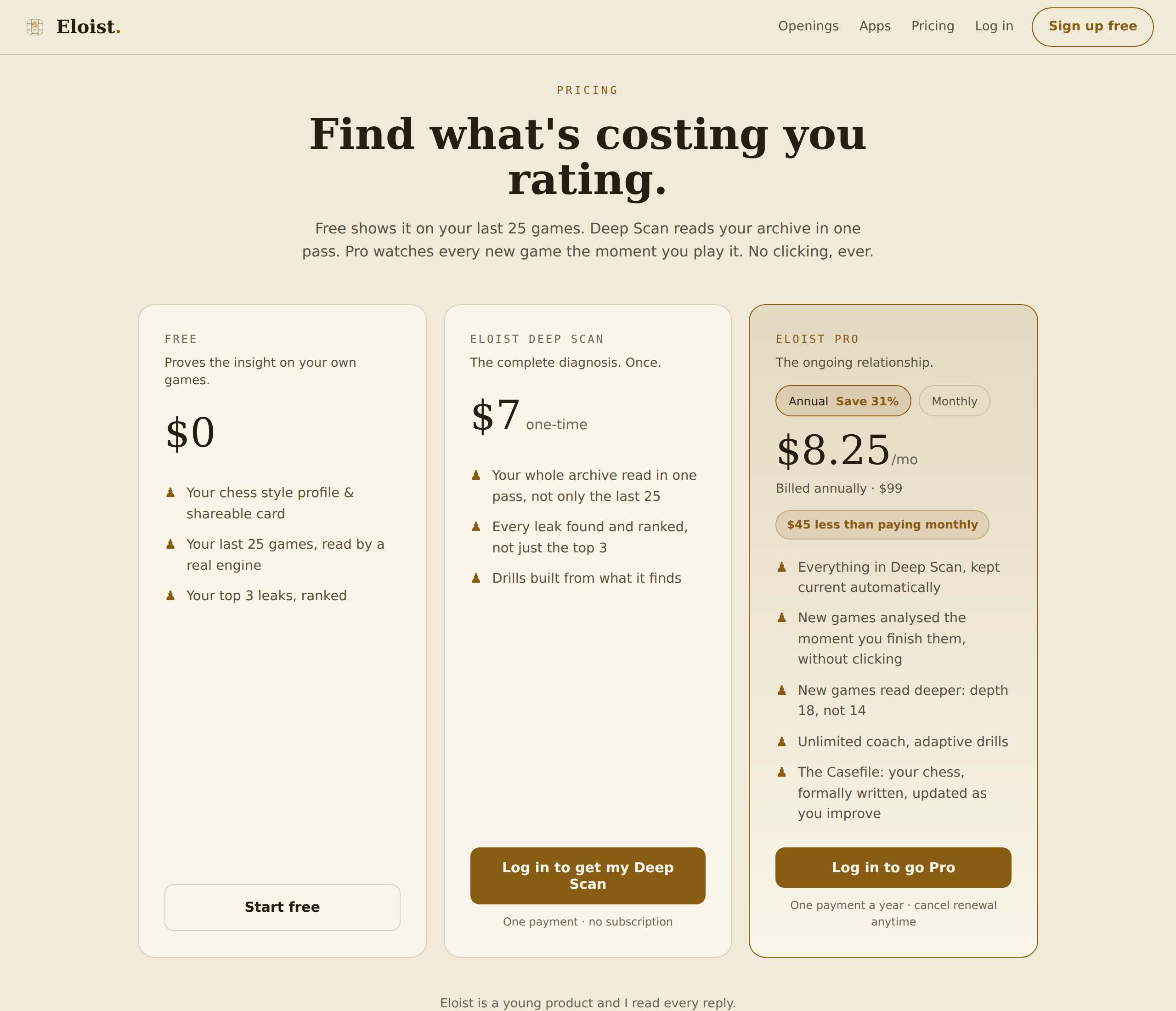
That framing is honest as far as it goes. Annual really is 31% cheaper than paying twelve monthly charges, and $8.25 really is what a year works out to per month. But look at where the emphasis lands. The two loudest lines on that card are both doing arithmetic on your behalf, and the thing you are actually being asked, which is whether to hand over $99 today, is the small print.
Why we did it
The argument was about payback. When someone pays us $12 a month, it takes most of a year before that subscription has covered what it cost us to reach them. When someone pays for a year up front, it covers itself immediately. Annual billing is the single biggest lever on how fast a young product can afford to keep going, and unlike raising the price it does not ask anyone to pay more.
We also had one real customer who had gone looking for the annual plan back when it was hidden behind an unselected tab, and found it. One person out of seven paying customers at the time, choosing the option the page was arguing against. We read that as suppressed demand.
Every sentence in the last two paragraphs is a fact about our finances. Not one of them is a fact about the person reading the page, who had known Eloist for about ten minutes and was being asked for a year of commitment on that acquaintance.
What happened next
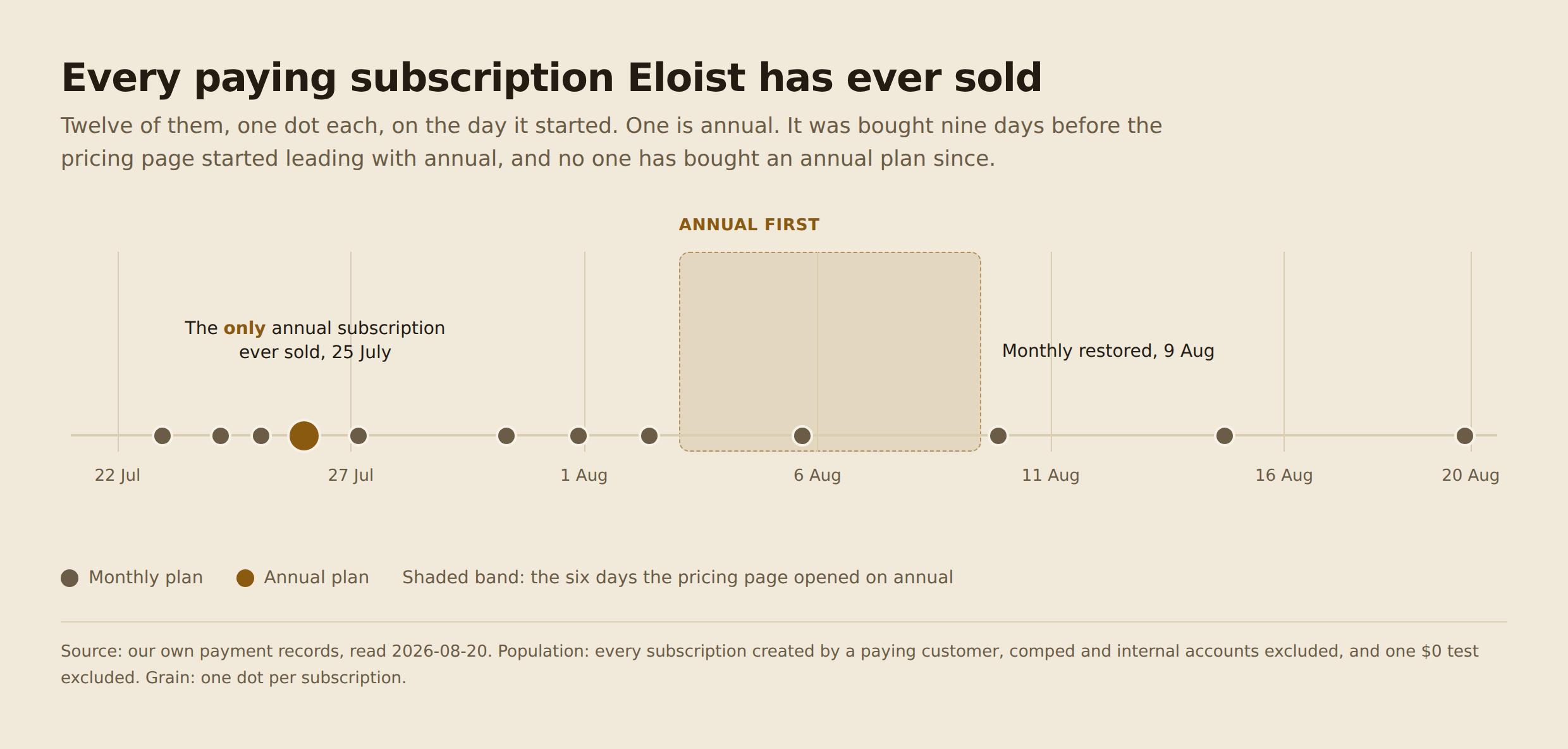
Twelve people have ever paid for an Eloist subscription, counted from our payment records on 20 August 2026, one row per subscription, with comped and staff accounts left out because they never paid anything. Eleven of those twelve are on the monthly plan. The twelfth bought the annual plan on 25 July, nine days before the page started leading with it.
So the headline result of making annual the default is that we sold no annual plans at all while it was the default, and we have sold none since. Our one annual customer bought it while the page was still arguing for monthly.
The obvious next question is whether it also cost us subscriptions in general, and this is where we have to stop and be careful, because the honest answer is that we cannot tell you.
The part where we do not know
Here are the two numbers, and here is why we are not going to divide one by the other. In the six days the page led with annual, 21 distinct people opened it. In the eleven days since we changed it back, 43 did. That is one row per person per arrival from our own click log, with our own devices and known bots removed. Over the same two stretches of days, our payment records show 1 new paying subscription and then 3.
The temptation is to turn that into two conversion rates and announce that one is better. We cannot, honestly. The visitor count and the subscription count come out of two different systems that do not share a reliable way to tell us that a given visitor is a given customer, so a rate built by dividing one by the other would be a guess wearing a decimal point.
And even at face value it settles nothing. 1 subscription against 3 is four subscriptions in total. We ran the standard test for whether two counts that small are really different and it found nothing: gaps this size fall out of pure chance almost every time. Four cannot carry a conclusion, and anyone who tells you otherwise is selling something.
There are two more reasons not to trust the comparison even if the numbers were bigger. On the same day we reverted, we shipped four other changes to how we ask for money, so the eleven days after 9 August are not a clean reading of anything. And the counter that produced those visitor numbers, one row per person per arrival, recorded nothing before 2 August, so there is no earlier stretch of days to compare against, only the two windows either side of a single change.
We changed it back on reasoning, not on proof. The reasoning still seems right to us. The proof does not exist yet, and pretending otherwise would make this a worse blog post and a worse company.
The mistake underneath the mistake
When we reverted on 9 August, we did have one piece of evidence we were proud of. Every person who had touched the monthly/annual switch had moved it the same way, off annual and onto monthly. Four out of four. It felt like the readers voting.
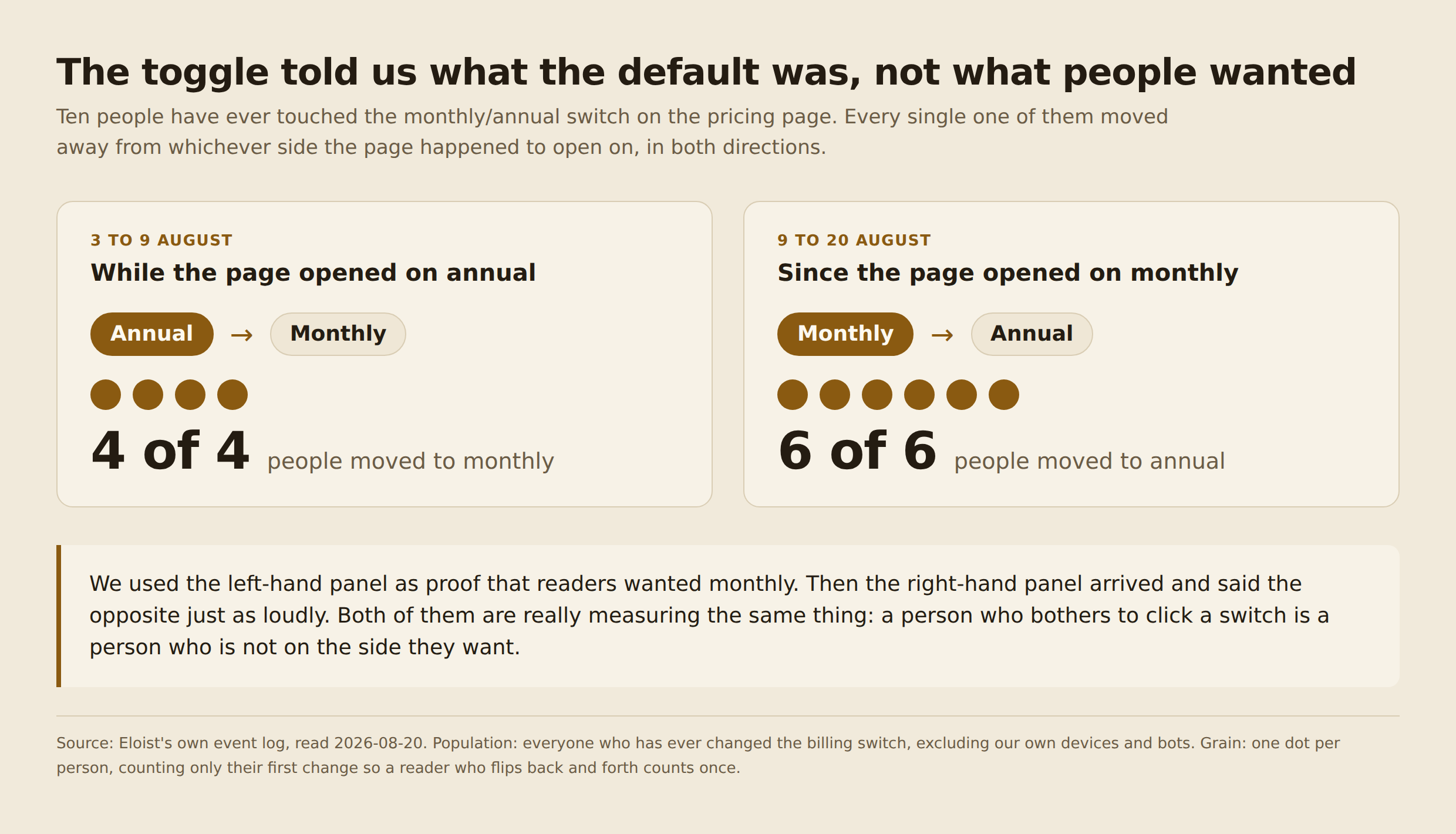
Since the page went back to monthly, six more people have used that switch, and all six moved to annual. Four out of four one way, then six out of six the other way, from the identical measurement.
Of course they did. A switch can only be moved off the side it starts on. Someone who arrives on the plan they want has no reason to touch it and leaves no trace, so the only people the counter can ever see are the ones who wanted the other thing. We were measuring our own default and calling it a preference.
That is the error we would most like back. Leading with annual was a judgement call made on incomplete information, which is most decisions. Reading a number that could only ever come out one way and treating it as the readers speaking is something else, and it happened to arrive at an answer we now think is correct, which is exactly what makes it dangerous.
Where it stands
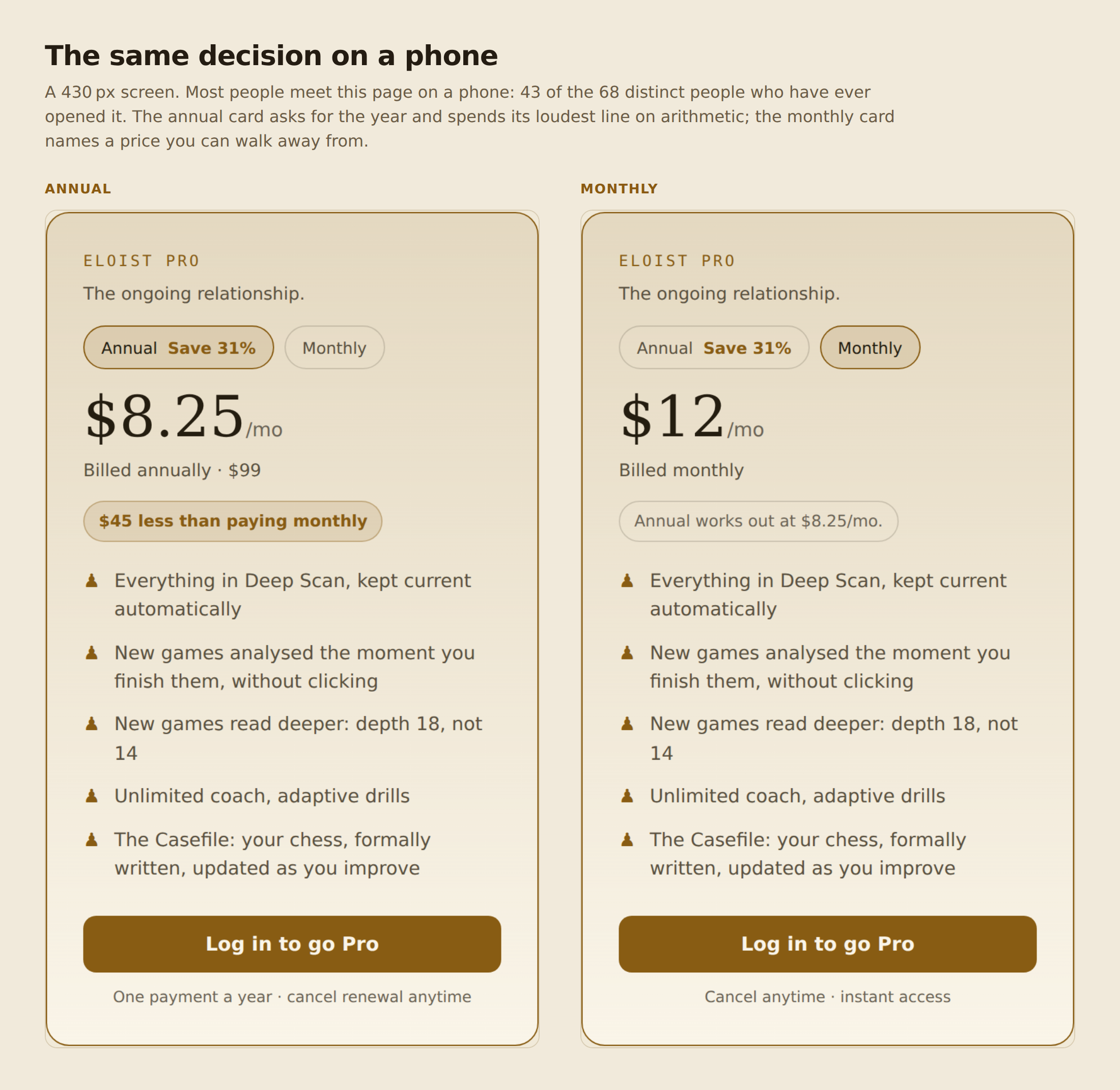
The page opens on monthly. Annual is still there, one visible tap away, still 31% cheaper than paying twelve monthly charges, and we would rather you took it once you know whether Eloist is any good. It should be a thing you choose in month three, not a wall we put in front of you in minute ten.
One loose end, which shows how these mistakes actually survive: the revert on 9 August fixed the pricing page and missed the home page, which kept quoting the annual price and sending people to a page that opened on monthly. It stayed wrong for the next ten days, on the busiest surface we have, because a decision got made in one place and written down in two. That is fixed, and there is now a test that fails the build if the price a card shows and the plan its button carries ever disagree again.
When there are enough subscriptions to say something true about this, we will write that down too, including if it turns out we were right for the wrong reasons.
See the pricing page →