The move that costs you most
We went through more than a million moves looking for the single pattern that bleeds the most rating. It turned out to be the reply.
You know the feeling. Your opponent hangs a knight, or walks into a fork, or grabs a pawn they had no business touching. Something in your chest goes loose. You play your move. And then, often enough that it stops being funny, the position is level again and you cannot quite say how.
We wanted to know which single move-pattern costs club players the most rating, so we went and measured it rather than guessing. Everything below comes from 1,295,106 moves played by 219 accounts across 40,918 engine-analysed games, taking each account's 200 most recent games and counting every account exactly once, so that one player with a huge archive cannot speak for everybody else. Throughout, a blunder means a move that hands back two pawns of evaluation or more.
First, the answer that was not there
The obvious place to look is the shape of the game. Everyone has a theory about it. The opening is fine and then move 20 arrives. The endgame is where it all goes. Time trouble at move 35. So we counted blunders by move number, for every account separately, and lined them up.
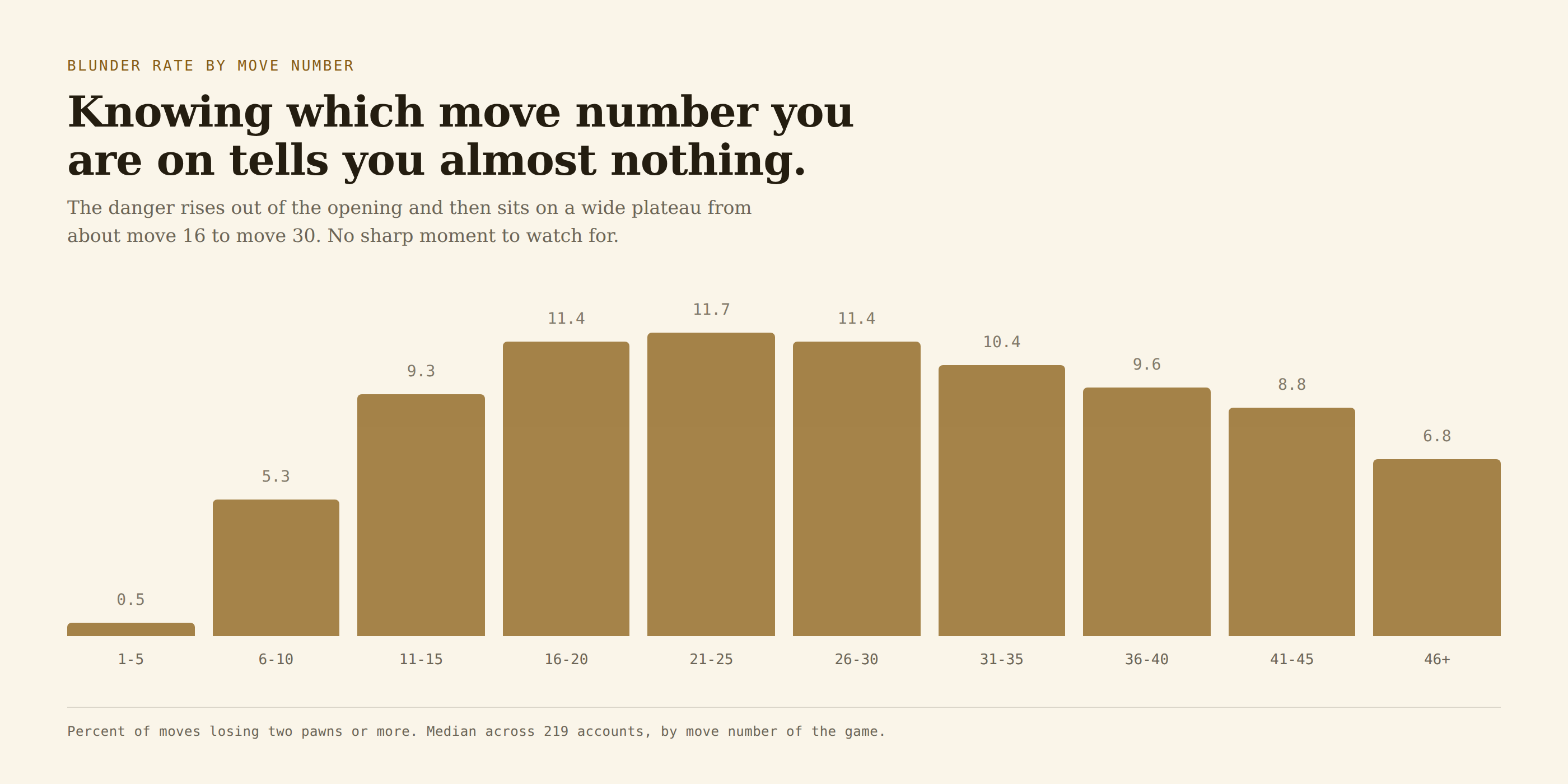
There is a real rise coming out of the opening, and then a plateau you could park a bus on. From move 16 to move 30 the rate sits between 11.4 and 11.7 percent and refuses to move. Knowing you are on move 22 rather than move 27 tells you nothing you can act on at the board. Whatever the expensive pattern is, it does not live on the move counter.
The pattern lives one move back
So we stopped asking where in the game and started asking what had just happened. For every move a player made, we looked at the move immediately before it, the opponent's move, and asked one question: did that move throw away two pawns or more? Then we split the player's moves into replies to a mistake and everything else.
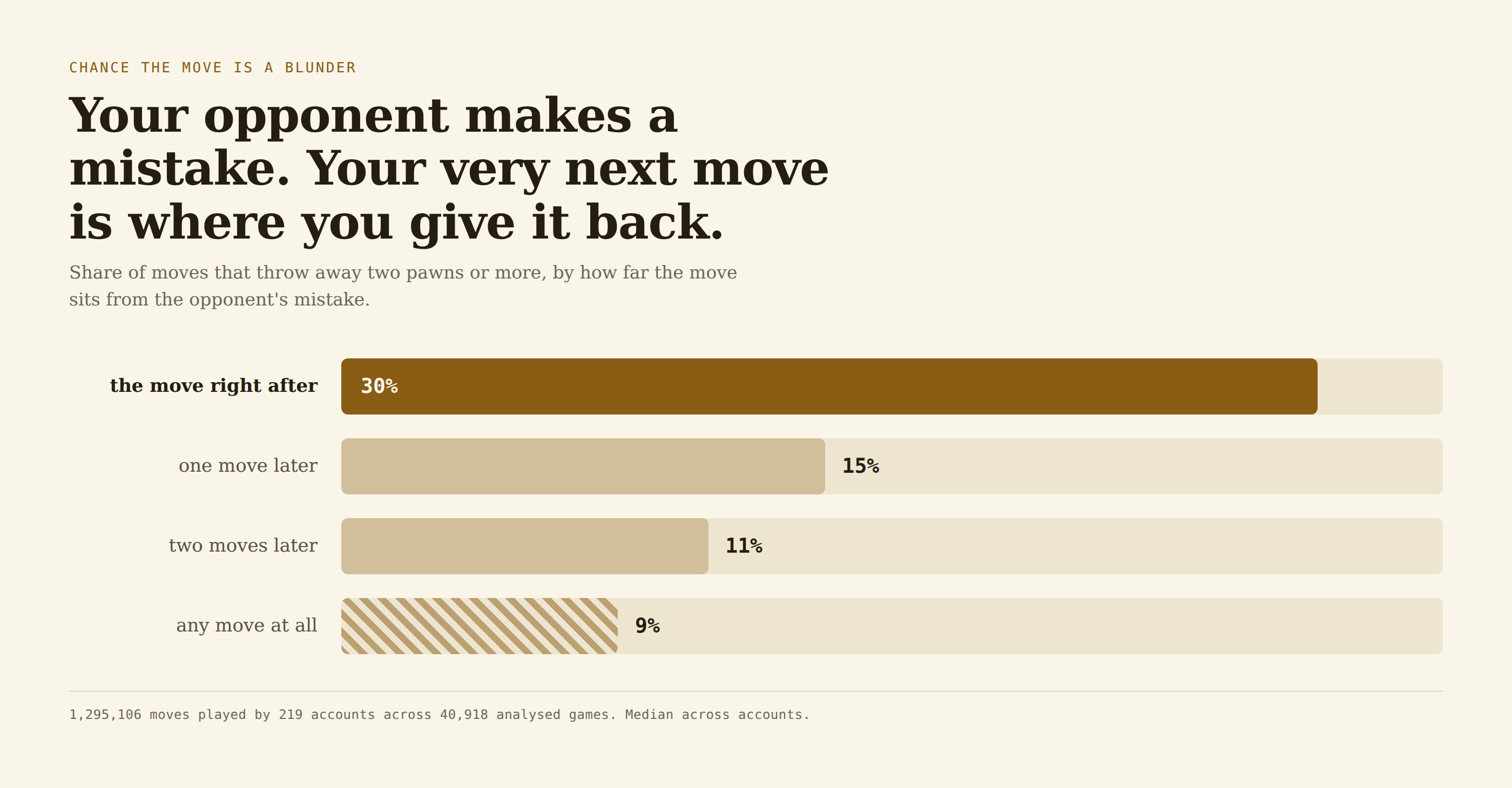
The replies blunder at 30 percent. Every other move blunders at 8.6 percent. That is the median account, and it is not a handful of tilters dragging an average around: all 219 accounts show the same direction, with the gap ranging from 2.4 times up to 7.6 times. Not one account we measured is immune to it.
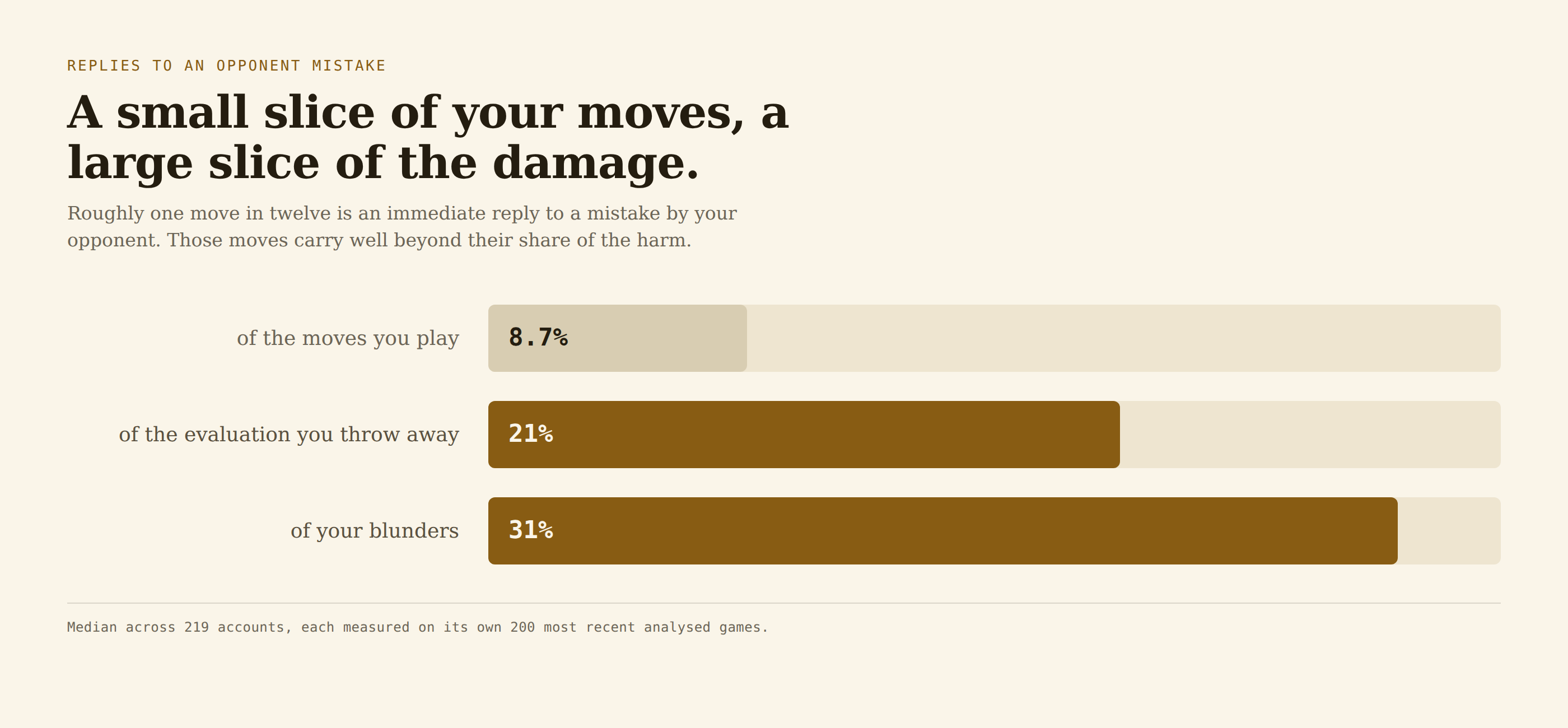
That is the part worth sitting with. These moves are 8.7 percent of what you play and 31 percent of your blunders. And the window closes fast. One move later the blunder rate has already fallen to 15 percent, two moves later to 11 percent, and after that you are back near your ordinary 8.6. The danger is one move deep.
We tried hard to kill it
A finding this tidy usually has something wrong with it, so the first job was to break it. The best objection is that when your opponent blunders you are often winning by a lot, and a big advantage is an awkward thing to carry. Maybe we had measured nothing more interesting than the difficulty of converting.
So we matched the positions. We sorted every move by how the game stood before it was played, then compared replies against ordinary moves inside each band.
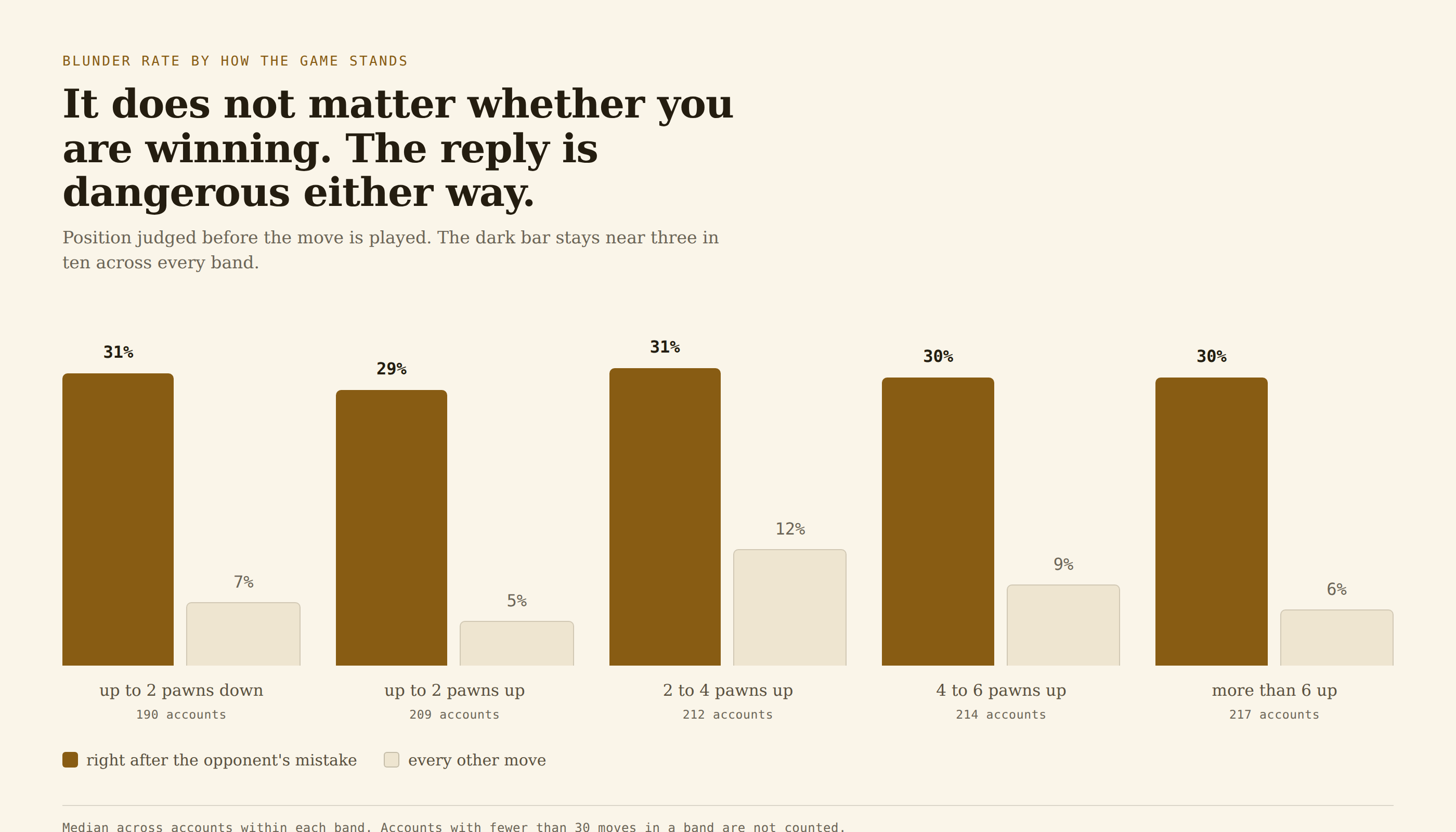
The reply blunders at close to three in ten no matter how the game stands. Two pawns down, six pawns up, dead level: it barely shifts. Whatever is going wrong on that move is not about the size of the advantage you are holding.
The second objection is engine noise. An engine that changes its mind about a position will look like an opponent blunder followed by a player blunder, when really it is one machine having second thoughts. So we threw away every case where the two plies before the mistake were themselves unsettled, keeping only replies that arrived after a genuinely quiet run of play. On the 217 accounts with enough of those clean sequences, the reply still blunders at 30 percent against 4 percent for every other quiet move. Tightening the test made the gap wider.
What it looks like in one game
Here is a three-minute game from one of our own accounts, a Grob Opening from 2024, which we are using instead of a customer's game for reasons we hope are obvious. Seventy moves, twelve blunders, and an average loss of 172 centipawns a move. Look at the evaluation.
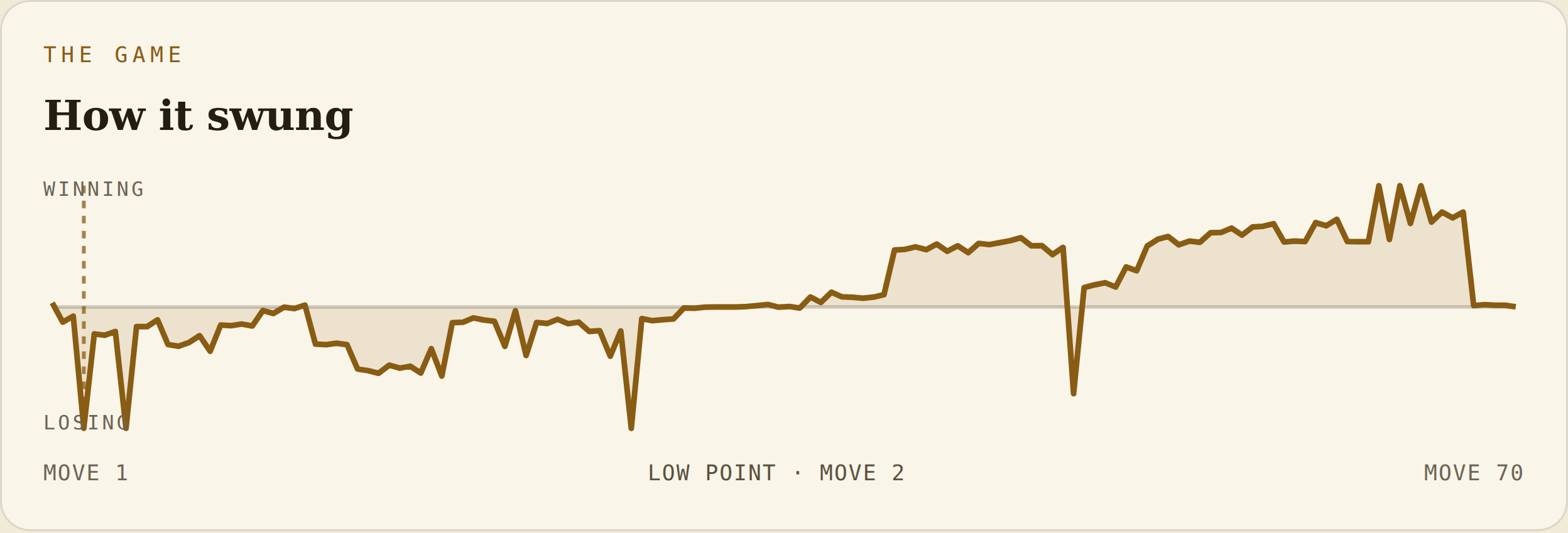
Watch moves 22 and 23. Black is winning by more than three pawns and plays Nxb2, taking a pawn with check. The advantage almost completely disappears. White, now in check and with a decision to make, plays Kd2, and stands four pawns worse than before the check ever arrived. Two moves, two gifts, and neither player able to bank the one they were handed.
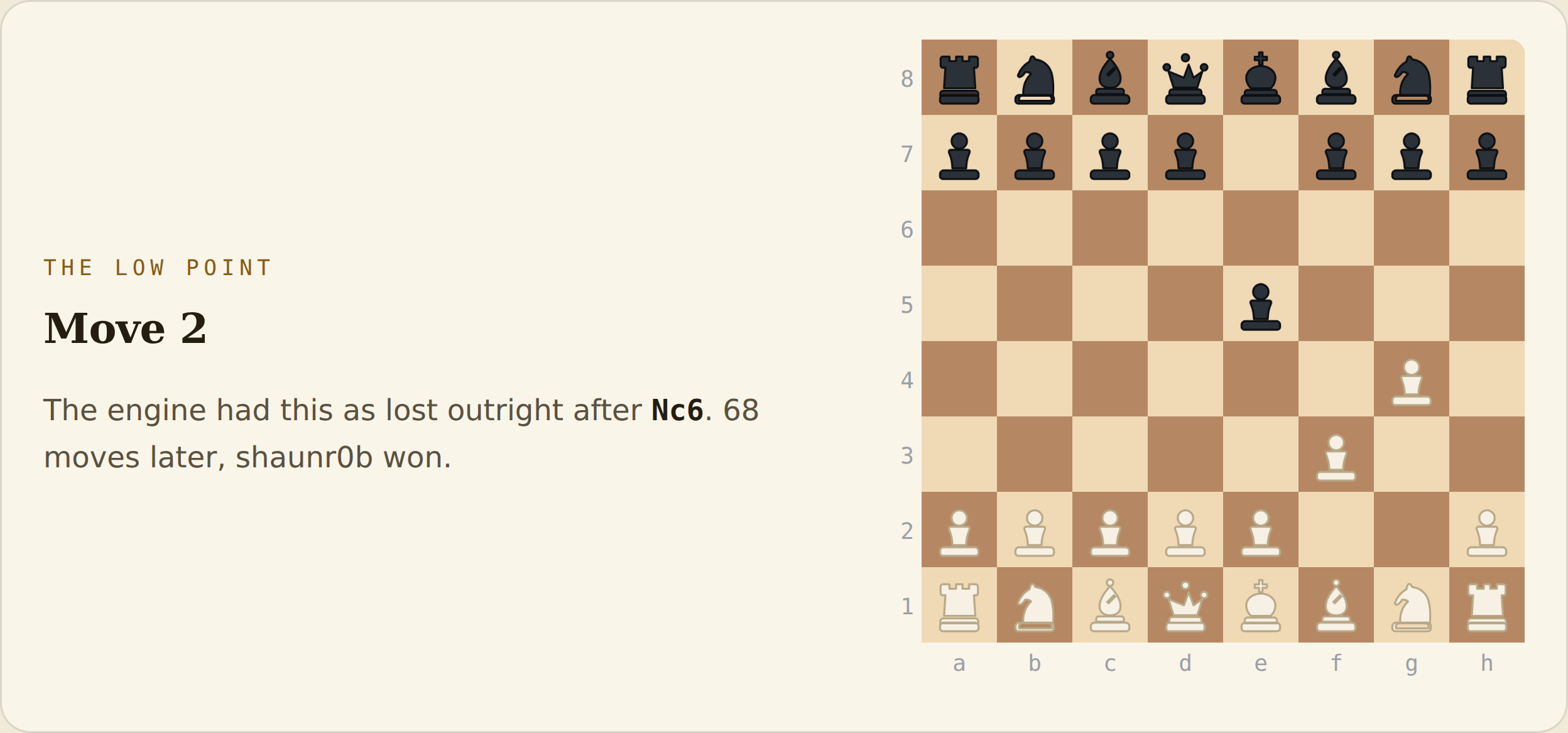
This game had already been given away once, long before that:
You cannot spot it by the shape of the move
We hoped the costly reply would have a tell, something like a greedy capture, a panicked check or a queen doing something ambitious. It has none. Looking at the single worst move of each game across 203 accounts, 23 percent of the ones that followed an opponent mistake were captures, against 21 percent of the ones that did not. Checks run 10 percent against 6 percent. The mix of pieces is close to identical either way.
So there is no move shape to be suspicious of. Timing is the only warning you get.
What to do about it
The practical version is short. When the position turns suddenly in your favour, that is the moment to slow down. Almost everyone does the opposite, because a gift feels like permission to relax, and because the winning move often looks obvious. It usually is obvious. The trouble is that the position underneath it has just changed, and you are still holding the plan you made for the old one.
One question is enough at the board: what changed? Not what do I win, which is where the eye goes on its own, but what is different now that was not different a second ago. Which of my pieces stopped being defended when that knight moved. Which square just opened behind the pawn they pushed. The answer takes ten seconds and it is the highest-paid ten seconds in your game.
There is one thing we still cannot tell you, and we would rather say so than dress it up. Our analysis does not carry the clock reading for each individual move, so we cannot yet say whether these replies are fast moves or slow ones. Our guess is that they are fast. A guess is all it is, and we are going after the answer next.
In the meantime, your own version of all this is sitting in your game history. Connect an account and every analysed game gets the review you have been looking at here: the whole evaluation, swing by swing, with the move that cost you most called out by name. Your own number beats a stranger's average every time.
Find yours →