The cheapest clicks bought the most expensive players
One ad won every number we were watching. It cost six times more per player than the ad running beside it.
We buy a small amount of advertising for Eloist, and we publish what it teaches us. This is the clearest thing it has taught us so far, and we got it wrong for about a week.
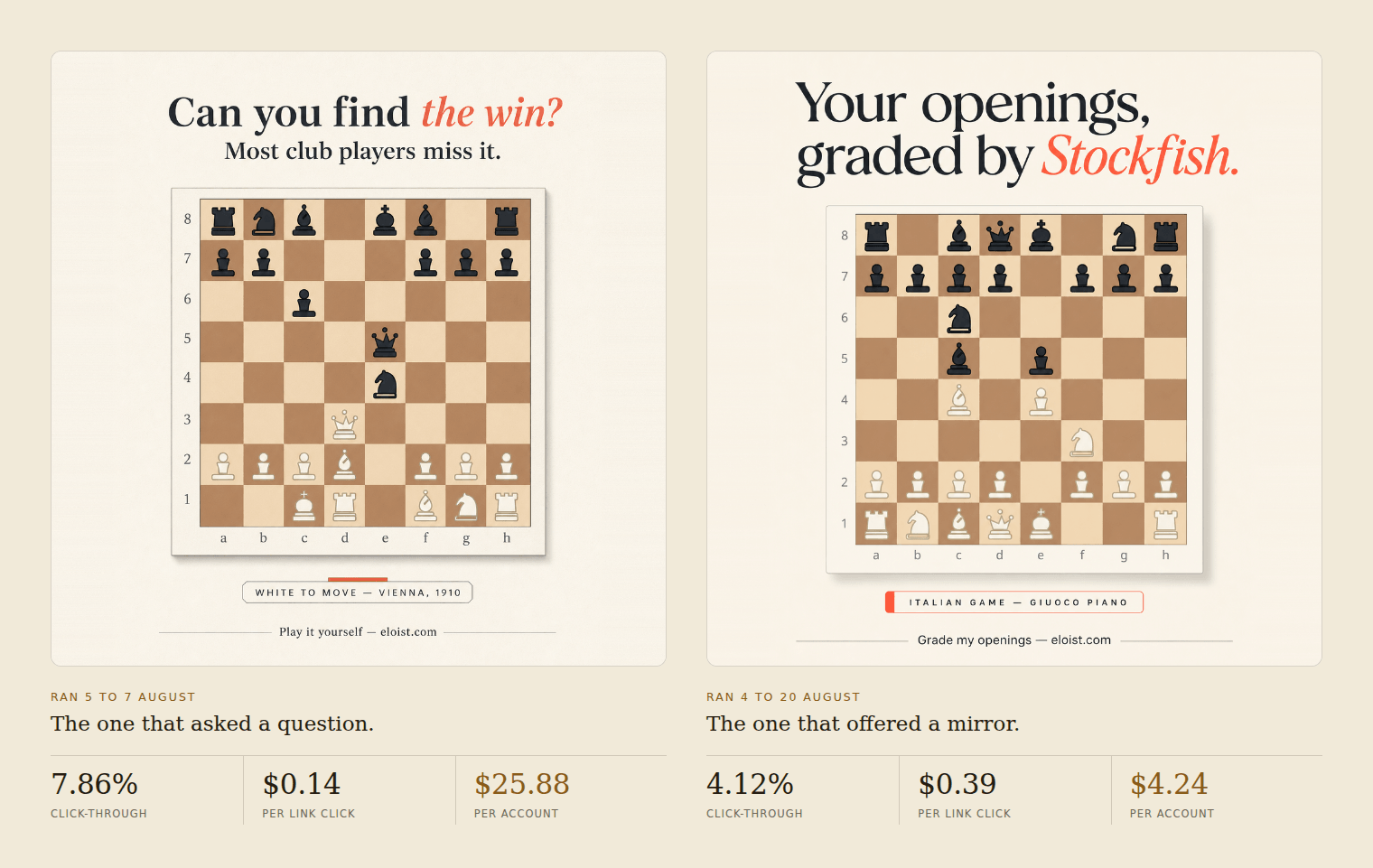
In early August we ran two ads inside the same campaign, on the same two networks, sending people to the same page. One showed a real position from a 1910 game and asked you to find the winning move. The other offered to grade the openings you actually play. On the numbers we were watching, the puzzle was the best ad we had ever run.
The ad that won everything we were measuring
The puzzle ad was shown 5,685 times and collected 447 clicks, of which 368 were real follows of the link rather than taps that only expanded the picture. That is a click-through rate of 7.86%, the highest of any ad we have spent more than $30 on, and it cost 14 cents per person who arrived. The openings ad managed 4.12% and 39 cents. If you rank our ads by attention, the puzzle wins and nothing is close.
Then we counted players instead of clicks, and the ranking turned over completely.
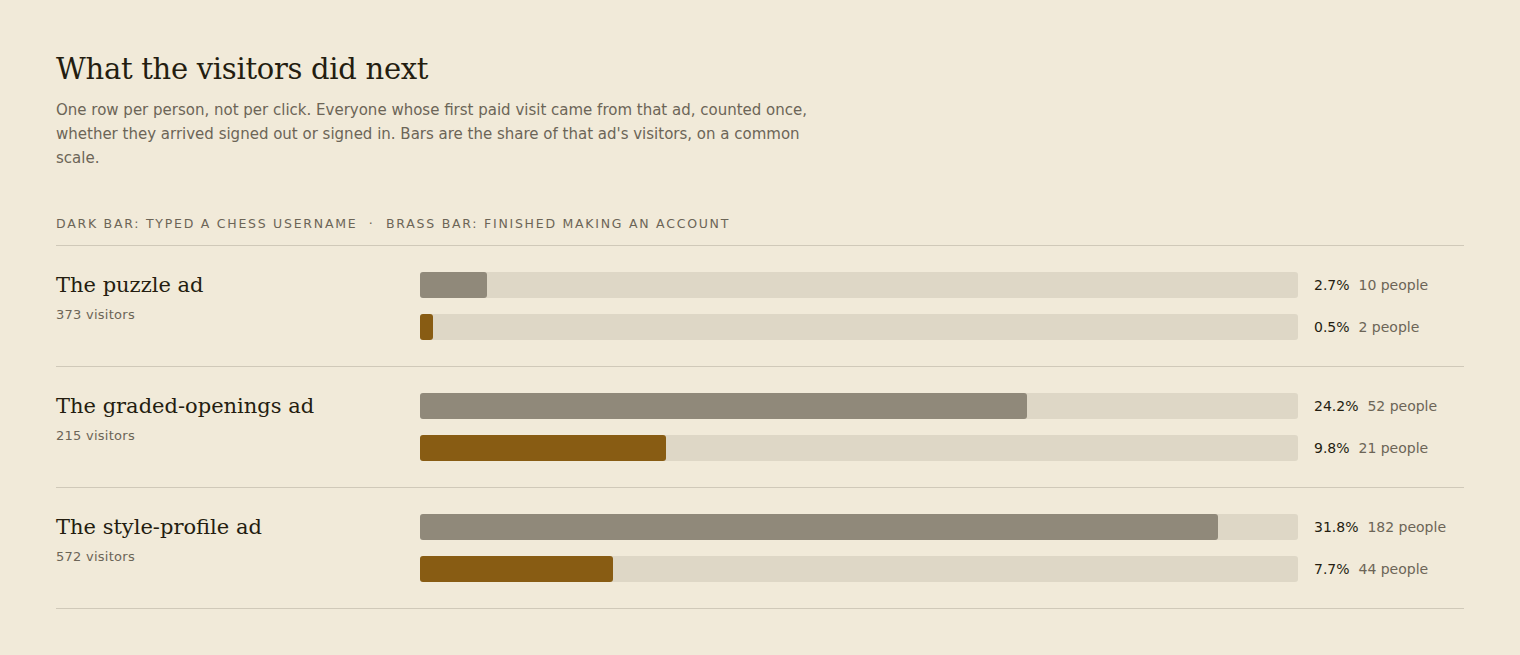
373 distinct people arrived from the puzzle ad. Two of them ended up with an Eloist account. That works out at $25.88 per player. The openings ad brought 215 people and produced 21 accounts, at $4.24 each. The ad with the cheap clicks was six times more expensive per player than the ad we had been quietly ignoring.
The page was not the problem
Our first guess was that we had broken the handover. Ads that promise one thing and deliver another lose people at the door, and that is an easy mistake to make. So we went and looked at what those 373 people saw.
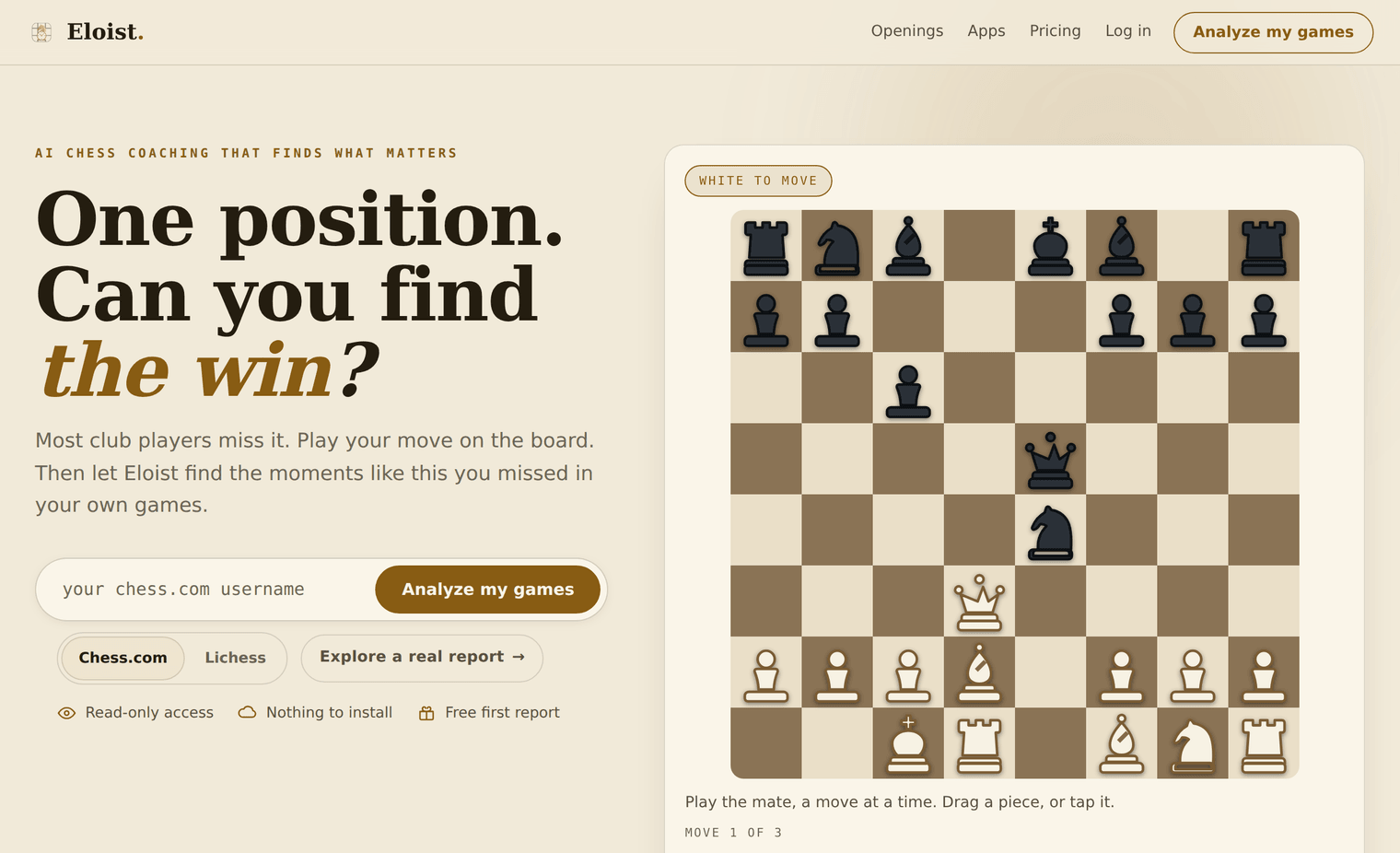
The handover was fine. The page put the exact position from the ad on a board you can move pieces on, and it did so before the ad started running. People played it, too. Of the 326 puzzle visitors who arrived after we started recording board moves, 55 played a move, 34 found the mate, and 17 asked us to show them the answer.
Ten of the full 373 typed a chess username. On the openings ad, 52 people out of 215 did. Same page, same week, same button, and a gap of nine to one in whether anyone reached for it.
What a click actually told us
A chess puzzle in a feed is very hard to scroll past. You see a board, your eye starts calculating before you have decided anything, and tapping is what happens next. That is a real reaction and there is nothing dishonest in it. It just does not mean the person wants their last 3,000 games read.
The openings ad asks a duller question, and it is a question about you. Anyone who taps it has already decided they are curious about their own play, which is the whole of what we sell. Fewer people tapped. Almost all of the right people did.
The uncomfortable part is that the headline which wins the most attention is the one that selects the least. Our best-performing creative was, in effect, buying us an audience of people who like puzzles, which is nearly everyone who plays chess and nearly nobody looking for a coach.
The tempting wrong lesson
It would be easy to leave here believing that high click-through rates are a warning sign. We checked, and they are not.
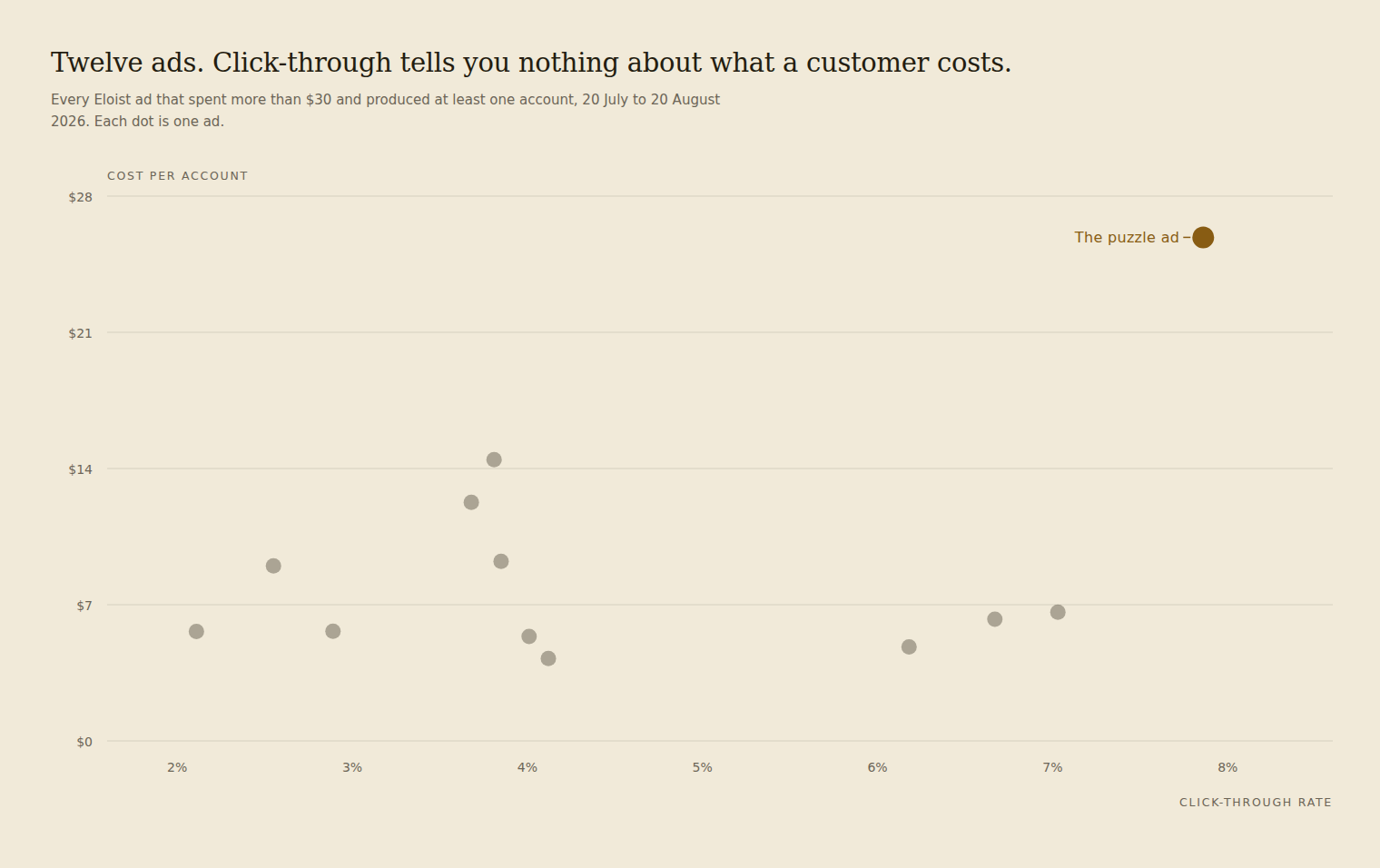
Across the twelve ads we have spent real money on, click-through rate and cost per player line up almost perfectly at random. Rank them by one and you have learned nothing about the other. The three ads sitting just below the puzzle on attention cost us $4.83, $6.25 and $6.61 per player, straddling our median of $6.43.
The finding is narrower and duller than a warning sign. A click is the cheapest thing a person can give you, so it carries almost none of their intent with it. We had been reading it as a signal mostly because it arrives fast and in volume, and because reading it saves you the awkward business of waiting a week.
What we watch now
We stopped judging ads on clicks and started judging them on the first thing a visitor does that costs them something. For us that is typing a chess username into the box, which is a small act of trust and takes about four seconds. On the four ads where we have been recording it, it picked out the one disaster on day one. Click-through had that ad top of the table.
The ad doing the most work for us now sends people to that page. It has the lowest click-through rate of the three in this piece, at 2.89%, and 44 of its 572 distinct visitors made an account, at $5.63 each. It sells the same thing the openings ad sells, which is a look at yourself.
How we counted, and what we would not lean on
Everything above counts people, not visits and not clicks. One person who arrives on a phone and comes back on a laptop is one person, and an account is counted once no matter how many times the form was submitted on the way there. We match each visitor to an ad by the numeric ad identifier carried on the link, never by the campaign name, because the name can arrive stale and has pointed at the wrong campaign for us before.
The window runs 20 July to 20 August 2026. Every figure was recounted from the ad billing records and from our own visit records at the same moment, over distinct people and finished accounts, rather than read off a dashboard.
The honest weakness is that the puzzle ad produced two accounts, and two is a small number to build an argument on. What we trust is the rate underneath it. Across every other ad that sent us anybody at all, 145 of 1,713 distinct people ended up with an account. At that rate, the puzzle ad's 373 distinct visitors should have produced 31 or 32 accounts. This was not an unlucky week.
We also have not shown you what these players are worth over time, because we have not been running long enough to know. When we do, we will write that one up too, and if it contradicts this piece we will say so.
See what your own games say →