Colle System: Pterodactyl Variation
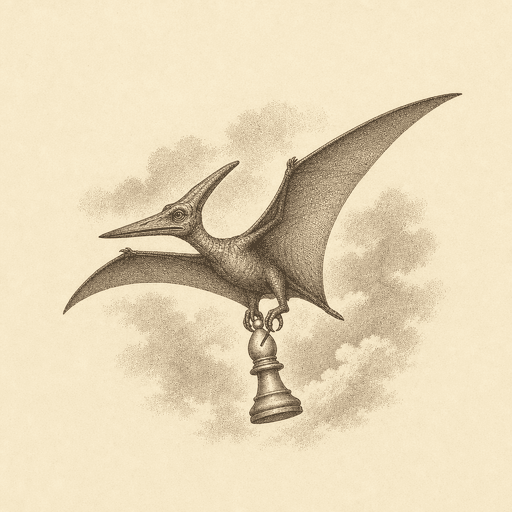
The Pterodactyl is a Modern Defense fianchetto with a ...c5 jab and an early queen check. It swoops at the Colle before White's setup is even finished.
The Pterodactyl is a family of Black systems built on ...g6, ...Bg7, ...c5 and an early queen sortie to a5. This name comes from the cheerfully unorthodox opening books of Eric Schiller and Bill Wall. Against the Colle System, the formula lands as 4...Qa5+, a check thrown in before White has finished the quiet e3-and-Bd3 furniture arrangement. It looks rude, and that's the intent. It asks White to commit a piece to blocking before the position has decided what it wants to be.
Here's the fine print, and it's funny: the most natural block, 5.c3, is a move many Colle players were going to make anyway. The check can end up costing Black time rather than gaining it. 5.Bd2 is the ambitious answer. It blocks while attacking the queen, forcing her to move again. The whole variation is a bet that a Colle player on autopilot will handle the small disruption poorly and leave d4 loose while the g7 bishop leans on it.
Underneath the branding, the machinery is familiar: long-diagonal pressure against d4, the ...c5 lever already in, quick development behind it. If you like Modern Defense structures and enjoy an opponent who is mildly annoyed by move four, this is a legitimate way to get there. The check's job is to change the mood, not to decide the evaluation.
White's best answer is the least dramatic one: block with 5.c3, which the setup wanted to play regardless. Keep developing. Castle, play Nbd2, and prepare the standard central break with e4. The queen on a5 can become a target: a later b4, supported by the c3 pawn, or a well-timed Bd2 gains time against her. Don't panic about the g7 bishop; keep d4 solidly defended and the long diagonal stays closed for business.
Black is playing a Modern Defense with an attitude: keep the g7 bishop trained on d4, play ...cxd4 at the moment it opens the diagonal most usefully, and bring the knights to f6 and c6 to gang up on the same square. The early check exists to knock White off a rehearsed move order and force decisions at the board. Afterwards the queen often resettles on b6 or c7 to keep working. White's imprecision brings Black free pressure. Well-timed White moves leave Black with a playable Modern structure in a game both sides must think through alone.
This exact line is a genuine rarity at club level (1600-2000 on Lichess): the position after 4.Bd3 appears about 24,000 times in the database, and only 0.7% of those games (172 in all) continue with 4...Qa5+. When it does happen, White blocks with 5.c3 in 58.7% of games (scoring 54%) or 5.Bd2 in 26.2% (scoring 50%). With a sample this small, treat every one of those percentages as a hint rather than a verdict.
- Family
- Colle System
- Category
- Semi-Closed
- First move
- 1.d4
- ECO
- A40
- Line
- 1. d4 g6 2. Nf3 Bg7 3. e3 c5 4. Bd3 Qa5+