Polish Opening
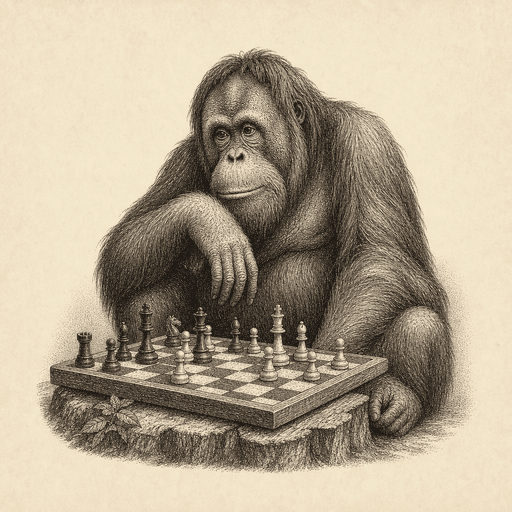
The b-pawn lunges two squares on move one: White trades central real estate for queenside space and a bishop that rakes the long diagonal.
1. b4 looks like a prank and plays like a plan. The pawn grabs queenside space and clears the way for Bb2, after which the bishop pressures e5 and eventually g7 from across the whole board. White is arguing that the classical center can be rented rather than owned: let Black occupy it, then chip at it from the wing while the b-pawn annoys everything on the queenside.
It has the best-documented name story in chess. At the New York 1924 tournament, Savielly Tartakower visited the zoo on a rest day, took a liking to an orangutan, and christened 1. b4 the Orangutan Opening before wheeling it out in the tournament itself. The Soviet master Alexei Sokolsky later gave the move its serious theoretical foundation. He wrote the definitive book on it, which is why you'll see it called the Sokolsky Opening, the Orangutan, or simply the Polish.
The central bargain shows up immediately in the main line: after 1...e5 2. Bb2, White is happy to let the b-pawn go, since 2...Bxb4 3. Bxe5 trades a wing pawn for a center pawn and leaves the b2-bishop's diagonal wide open. That's the whole opening in one exchange. White gives up the flank to buy the center's most important square. At club level, the arrangement works better than its reputation.
White plays the wing game: Bb2 on the long diagonal, e3 and Nf3 to develop, a3 or a well-timed b5 to make the advanced pawn a lasting space advantage, and c4 to start real queenside play. Against 1...e5, the plan sharpens. Offer the b-pawn, capture on e5, and let the unopposed dark-squared bishop become the best piece on the board. The middlegame usually lives on the queenside, where White's pawns arrived first.
Black's soundest approach is to accept the gift of the center: either 1...e5, meeting 2. Bb2 with 2...Bxb4 and trusting that development plus the center outweighs the traded pawn, or a calm 1...d5 setup with classical development. The practical keys are these two: blunt the b2-bishop, often with ...f6 or a pawn on e5 that's actually defended, and don't let the b-pawn cramp the queenside for free. Play the position like it's normal chess, because it is; the numbers punish Black players who treat it as a joke.
At club level (1600-2000 on Lichess) 1. b4 opens 0.5% of games. Nearly 12 million positions in our database track it, and it scores 53% for White, better than its novelty reputation suggests. The main replies do not impress: 1...e5, chosen 36.6% of the time, scores just 45% for Black, while 1...d5 (20.4% of games) and 1...e6 (10.5%) both score 46%. The reply that actually holds its ground is plain development. 1...Nf6, played in 11.8% of games, scores a full 50% for Black.
Savielly Tartakower — Named it the Orangutan after a zoo visit during the New York 1924 tournament, then played it in the event. The most charming naming story in the opening catalogue.
Alexei Sokolsky — The Soviet master who took 1. b4 seriously enough to write the definitive monograph on it; in much of the world the opening carries his name.
- Family
- Polish Opening
- Category
- Flank
- First move
- Other
- ECO
- A00
- Line
- 1. b4