Hippopotamus Defense
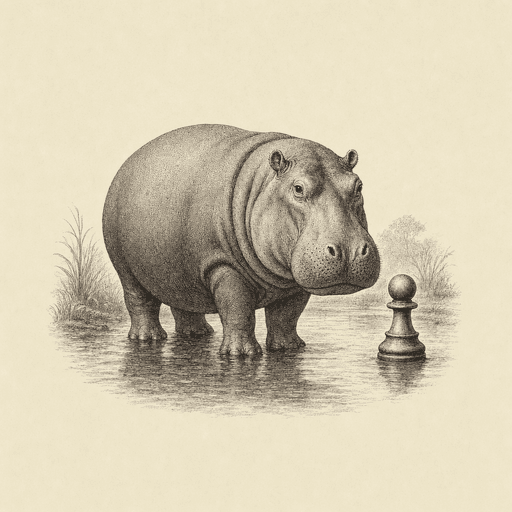
A first-move knight to the rim. The bluntest possible doorway into the low, patient, spring-loaded Hippopotamus family.
1...Nh6 develops a piece technically to the one square your first coach told you to avoid. But the move has a family behind it: the Hippopotamus. This is the school of setups where Black keeps every pawn modest, tucks the pieces inside a compact shell, and waits for White to overreach. From h6 the knight has a real square in mind: f7, one hop away. There it guards the king's neighborhood and supports a later ...e5. The classic Hippo usually arrives by quieter move orders. This is the version that announces itself at the door.
The Hippo's credibility peak is well documented. Boris Spassky used its setups in his 1966 World Championship match against Petrosian. A different move order, but the same animal, and it held up on the biggest stage the game has. The 1...Nh6 version adds an immediate dare: at some point White can consider taking on h6 to damage the shell. Black must decide whether a wrecked pawn front is fair payment for the bishop pair and an open g-file. Some Hippo players want exactly that argument. Most opponents have never had it.
In practice this is an anti-theory weapon and the terms of the deal are honest: White will get a big center for free, and Black bets the game on the shell absorbing it. The database adds a pointed footnote: White's timid setups do noticeably worse than the principled ones. If you face 1...Nh6, take the center. If you play it, that is exactly what you are hoping White won't do.
Accept the gift: e4 and d4, pieces to natural squares, and a real decision about the h6 knight. Bxh6 damages Black's kingside if the g-pawn must recapture, but concedes the bishop pair, so time it rather than rush it. After that, the plan is restraint with space: keep the big center flexible, finish development, and avoid the one mistake the Hippo is built to punish. That mistake is lunging forward until the position bites back.
Assemble the shell: ...g6 and ...Bg7, modest pawns on d6 and e6, the h6 knight often sliding to f7 where it covers the king and backs up a timely ...e5. Keep all three breaks (the pawn advances ...e5, ...d5, and ...f5) available and unplayed until White's center commits. Then open the position on your terms. The Hippo is a counterpunching opening. The moment you attack first, it stops working.
At club level (1600-2000 on Lichess), 1...Nh6 is a true rarity. About 124,000 games out of the 1.4 billion that begin 1. e4 contain this move. White's reply is nearly automatic: 63.5% play 2. d4. This move scores 54% for White. 2. Nf3 (13.6%) scores 52%, and 2. Bc4 (5.8%) scores 53%. The telling number is 2. d3: the timid option scores just 47% for White, below break-even. The knight on the rim forgives caution; it struggles against a full center.
Boris Spassky — gave the Hippopotamus its moment of legitimacy by using the setup in his 1966 World Championship match against Petrosian, a different move order, but the same animal
- Family
- Hippopotamus Defense
- Category
- Semi-Open
- First move
- 1.e4
- ECO
- B00
- Line
- 1. e4 Nh6