English Orangutan
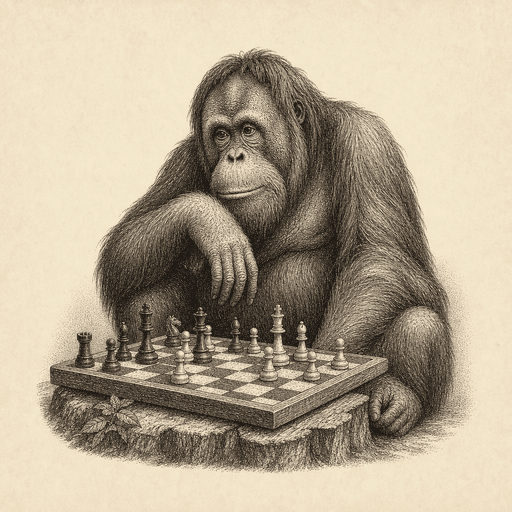
An English that changes its mind on move two. The b-pawn lunges, and the game turns into Tartakower's Orangutan wearing a sensible coat.
The name is one of the best-documented jokes in chess. During the New York 1924 tournament, Savielly Tartakower visited the zoo. He took a liking to an orangutan there. He christened 1. b4 the Orangutan Opening in its honor. The English Orangutan is that idea with a one-move delay: White opens with the respectable 1. c4. It waits for 1...Nf6. Then it lunges with 2. b4 anyway.
The two flank pawns stake out real queenside space. The follow-up writes itself: Bb2 takes the long diagonal. It aims straight through the center at Black's f6 knight. b5 often comes with tempo to chase pieces and grab more ground. Behind the eccentric face sits a normal soul: e3, Nf3, a quick castle. White's middlegame runs down the b- and c-files. The cost is just as visible: b4 is loose. The kingside is undeveloped. Black gets a free hand in the center.
That trade-off is the whole opening. Against a booked-up opponent it concedes a little. Against a club player who has never seen it, the unfamiliarity is worth more than the structure. Black's most reliable answers are the natural ones: fianchetto with ...g6 to contest the long diagonal, or the simple ...e6 and ...d5. The sharp ...e5 invites the same kind of pawn-grab mess that made 1. b4 famous.
Space first, questions later: push b5 at the right moment to harass a knight or clamp the queenside. Put the bishop on b2 where it stares down the long diagonal at f6 and beyond. Finish development modestly with e3, Nf3 and a short castle. The center stays flexible on purpose. White would rather play on the queenside files than commit a central pawn early. In many games the queenside pawns simply keep walking.
Develop as if the b-pawn were slightly embarrassing, because it is: ...g6 and ...Bg7 contest the diagonal White wants. ...e6 with ...d5 takes the center White declined. The little move ...a5 asks b4 to justify itself immediately. No violence is needed. Natural moves leave Black at least equal. Avoid drifting, because White's space grows on its own if nobody questions it.
At club level (1600-2000 on Lichess), this is a genuine surprise weapon. From 1. c4 Nf6, only 0.2% of White players choose 2. b4. It scores 47% for White, below break-even. The full position shows up in about 62,000 games in our database, some arriving via 1. b4 move orders. Black's mainstream answers all hold: 34.3% choose 2...g6 and 26.7% choose 2...e6, each scoring 53% for Black. 2...e5 (16.8%) scores the same 53%.
Savielly Tartakower — Christened 1. b4 the Orangutan after his zoo visit during New York 1924. This line borrows both the name and the lunge.
Alexei Sokolsky — The Soviet theorist who took 1. b4 seriously enough to write its definitive book. The English Orangutan is the c4-first cousin of his opening.
- Family
- English Orangutan
- Category
- Flank
- First move
- 1.c4
- ECO
- A15
- Line
- 1. c4 Nf6 2. b4